Most tech leaders assume building a custom AI agent is vastly more expensive than using a framework like LangChain or AutoGen. The truth? For many, it's the opposite. We've seen UK startups spend upwards of £45,000 on framework-based solutions that became rigid and expensive to scale, only to later rebuild them as custom agents for a fraction of the long-term cost. This article cuts through the hype to show you what's truly feasible and cost-effective in 2026.
Frameworks: The Quick Start Trap
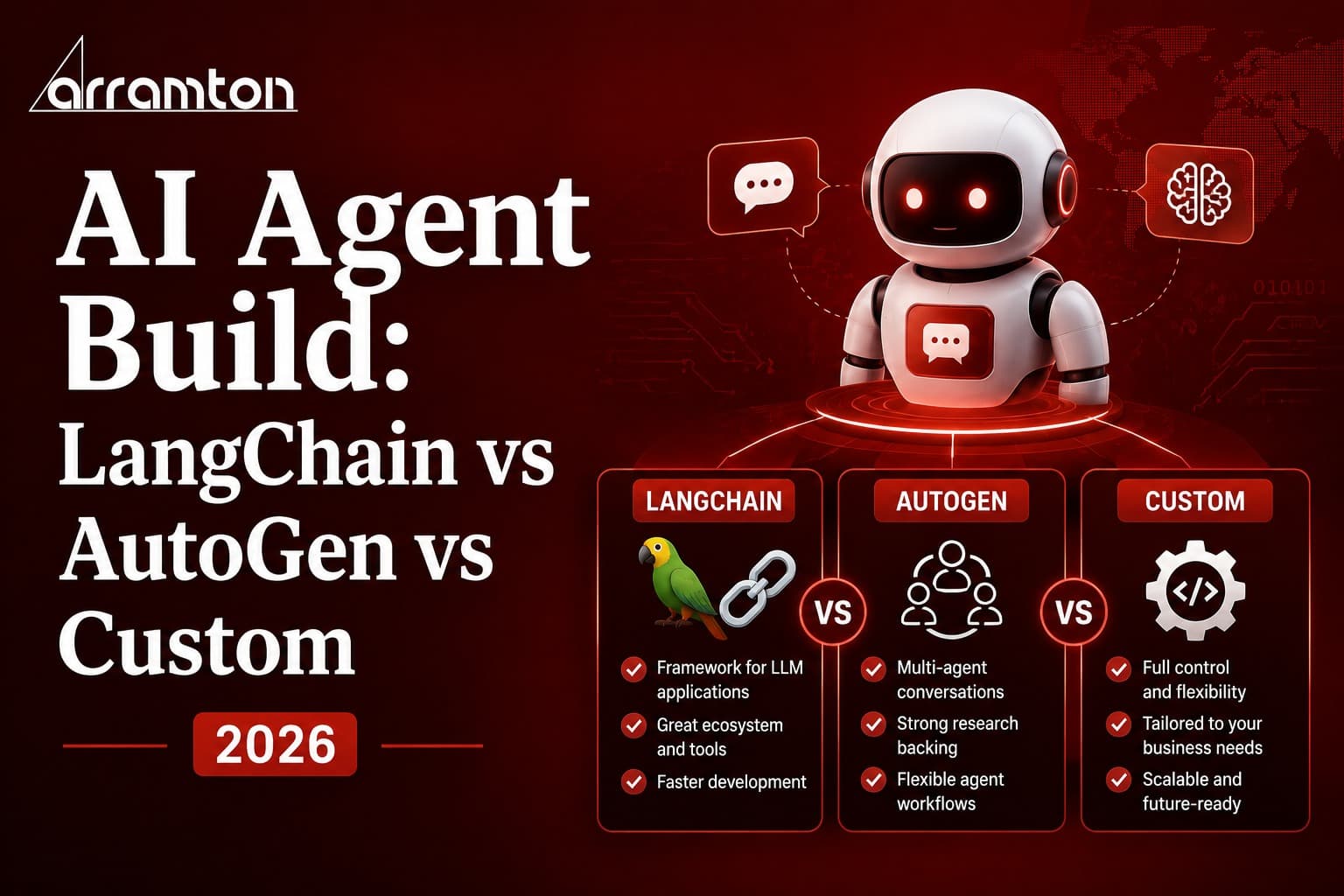
LangChain and AutoGen offer compelling pathways to quickly assemble AI agents. They provide pre-built components, chains, and agents that abstract away much of the underlying complexity. This speed is invaluable for proof-of-concepts and initial development.
LangChain: Orchestration Powerhouse
LangChain excels at building chains of calls to large language models (LLMs) and integrating them with external data sources. Its strength lies in its modularity, allowing developers to chain together various components like prompts, output parsers, and retrievers. For a US-based fintech looking to summarise quarterly reports, LangChain could rapidly connect an LLM to a document loader and a summarisation prompt.
AutoGen: Multi-Agent Conversations
AutoGen, from Microsoft, focuses on enabling conversations between multiple AI agents. It's designed for more complex workflows where different agents with specific roles collaborate to solve a problem. Imagine a UK e-commerce business using AutoGen to have one agent handle customer service queries, another manage order fulfilment data, and a third escalate complex issues to human support.
The Downsides of Abstraction
While frameworks accelerate initial development, they often introduce hidden costs and limitations. As your agent's requirements become more specific, you'll find yourself fighting the framework's architecture. This often leads to workarounds, performance bottlenecks, and significant vendor lock-in. What starts as a £5,000 experiment can quickly balloon into a £30,000 technical debt.

Custom AI Agent Builds: Precision and Control
Building a custom AI agent from scratch, or with minimal reliance on third-party frameworks, offers unparalleled flexibility. This approach involves direct integration with LLM APIs (like OpenAI's), custom data handling, and tailored agent logic. It demands more upfront engineering expertise but pays dividends in the long run.
When Custom Makes Sense
A London-based legal tech firm developing a contract review AI found that pre-built LangChain components struggled with the nuanced, domain-specific language. They opted for a custom build, integrating a fine-tuned LLM with a bespoke data ingestion pipeline and a custom agentic loop. This allowed them to achieve an 85% accuracy rate in identifying critical clauses, something frameworks couldn't match out-of-the-box.
Direct API Integration Benefits
By calling LLM APIs directly, you retain full control over prompt engineering, model selection, and data flow. You’re not limited by a framework’s abstractions. This is crucial for applications requiring strict adherence to data privacy regulations (like GDPR for UK clients) or those needing to integrate with proprietary systems. You can optimise for cost and performance far more effectively.
The ‘So What?’ for Your Business
If your project has unique requirements, requires high levels of customisation, or needs to operate within strict compliance frameworks, a custom build is likely more economical and performant long-term than forcing a framework to fit. It’s about building the right tool, not just a fast one.

Comparing the Total Cost of Ownership (TCO)
The headline cost of development is only one part of the equation. Total Cost of Ownership considers development, deployment, maintenance, scaling, and customisation efforts over the agent's lifecycle. For many, this is where frameworks falter.
Frameworks: The Long Tail of Costs
Initial development with LangChain or AutoGen might seem cheaper, perhaps £8,000–£20,000. However, as the agent needs to handle more complex tasks, integrate with more systems, or scale to higher volumes, the costs begin to climb. Custom modifications within a framework can be disproportionately expensive. Support can also become an issue if the framework’s community or maintainers shift focus.
Custom Builds: Upfront Investment, Long-Term Savings
A custom agent might have a higher initial development cost, ranging from £15,000 to £35,000 for a moderately complex agent. However, this investment buys you architectural freedom. Scaling custom solutions is typically more straightforward and cost-effective. Maintenance is simpler because you understand every line of code and its purpose. We've seen projects where a custom agent built for £25,000 replaced a framework-based one that was costing £10,000 per quarter in updates and scaling issues, delivering a full ROI within 18 months.
The biggest financial drain for UK and US businesses building AI agents isn't initial development, but the ongoing cost of adapting rigid, framework-based solutions to evolving needs.
When to Use Which: A Decision Framework
Choosing between a framework and a custom build depends on your project's specific needs, your team's expertise, and your long-term goals.
Choose Frameworks If...
Your project is experimental, a proof-of-concept, or requires rapid prototyping. You need to quickly explore LLM capabilities or build a tool for internal use that has a short lifespan. For example, a US marketing team wanting to test prompt variations for social media content generation might use LangChain for a few weeks.
Choose Custom Builds If...
Your agent needs to handle sensitive data, comply with strict regulations, or integrate deeply with existing enterprise systems. If the agent is core to your business operations, requires high performance, or needs to scale significantly, custom development is the prudent choice. A Series B startup building a core AI for their SaaS platform would fall into this category.
Arramton's Experience: Building for Scale
At Arramton, we've seen this pattern across over 30 AI and custom software projects — teams often start with frameworks for speed, only to encounter scalability and customisation hurdles later. We've helped clients migrate from complex, over-engineered framework solutions to streamlined, cost-effective custom builds that meet their exact requirements.

What Nobody Tells You About AI Agent Maintenance
Maintaining an AI agent, whether built with a framework or custom, is an ongoing effort. Frameworks can introduce ‘hidden’ maintenance costs as their underlying libraries or dependencies are updated, potentially breaking your existing chains or agents. You're reliant on the framework maintainers.
Custom builds require dedicated development resources, but you control the upgrade path. You can refactor code for efficiency, update models, and adapt to new requirements on your terms. This is the key difference: control over your technical roadmap. For a company in the UAE exploring AI for logistics optimisation, this control is paramount for ensuring future-proof solutions.
FAQs: Your Questions Answered
How much does it cost to build a custom AI agent in the UK?
Custom AI agent development in the UK typically ranges from £15,000 to £35,000 for a moderately complex agent. The final cost depends on the agent's specific functionalities, integration needs, and the expertise of the development team.
Is LangChain cheaper than building a custom AI agent?
Initially, yes, frameworks like LangChain can be cheaper for rapid prototyping. However, the total cost of ownership is often higher due to limitations in customisation, scaling challenges, and potential long-term maintenance complexities compared to a well-architected custom solution.
What are the main benefits of AutoGen for AI agents?
AutoGen's primary benefit is its ability to facilitate conversations and collaboration between multiple AI agents with distinct roles. This is ideal for complex, multi-step tasks that require specialised agents to work together.
When should I consider a custom AI agent build over using AI frameworks?
You should consider a custom build when your AI agent requires high customisation, strict data privacy compliance (like GDPR), needs to integrate with proprietary systems, or is a core component of your business that demands robust scalability and performance.
Conclusion
The decision between using LangChain, AutoGen, or building a custom AI agent in 2026 hinges on whether you prioritise initial speed and ease of use, or long-term agility, control, and cost-efficiency. Frameworks offer a fast start, but custom development provides the foundation for sustained innovation and scalability.
If you're evaluating partners for building an AI agent that aligns with your long-term business strategy, Arramton builds custom AI solutions and scalable integrations for UK and US companies, ensuring you don't get trapped by framework limitations.