The Automation Spectrum: From Rule-Based to Autonomous AI
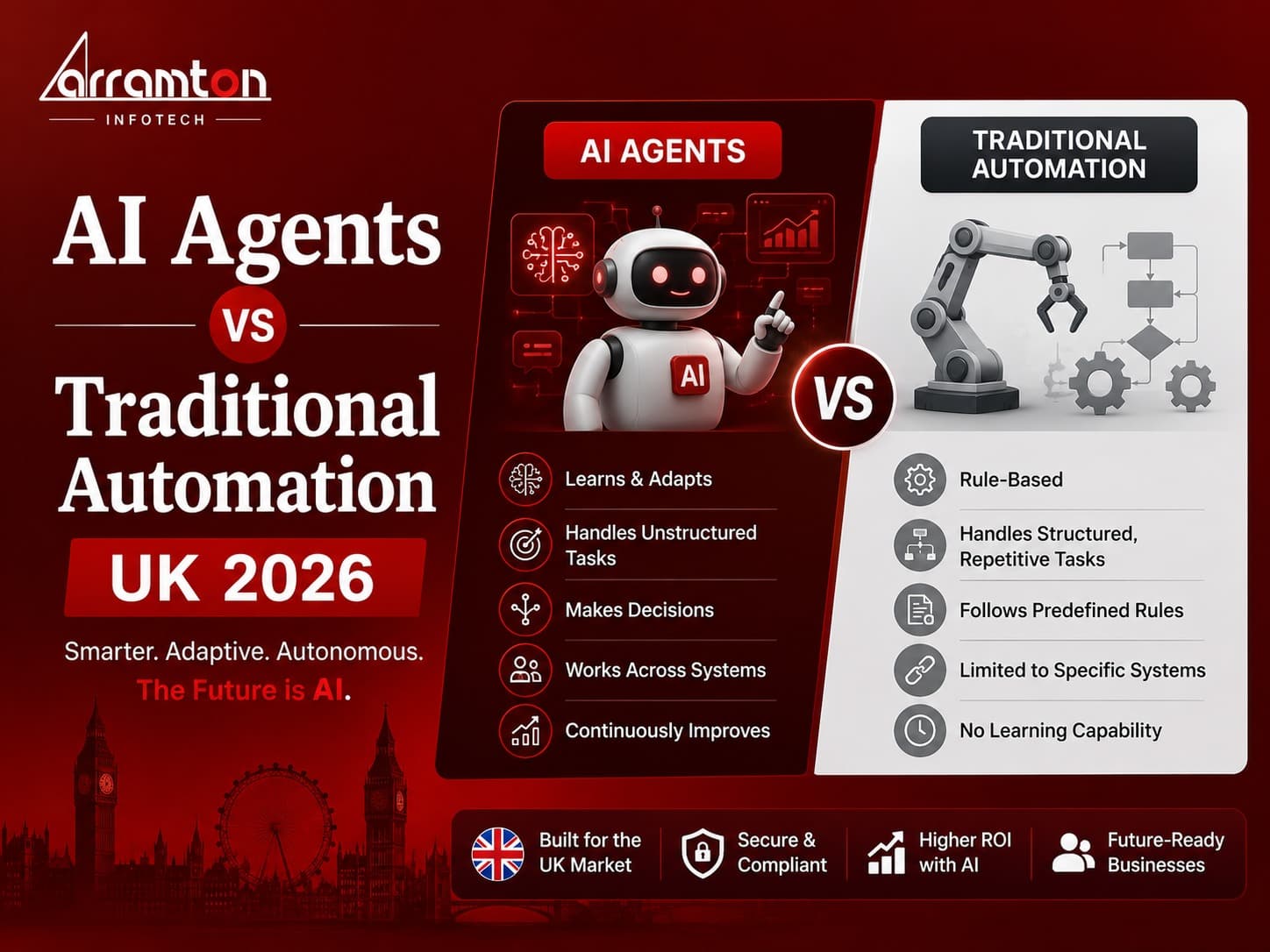
Building automation in 2026 isn't a simple fork in the road. It's a spectrum. On one end, we have rigid, rule-based systems that execute pre-defined steps with zero deviation. Think of a simple conveyor belt that moves boxes from A to B. On the other, we have sophisticated AI agents capable of reasoning, learning, and acting autonomously in complex, unpredictable environments. Understanding this spectrum is crucial for UK businesses looking to invest wisely in efficiency. It’s not about picking 'automation' or 'AI'; it's about selecting the right tool for the specific job.
Traditional automation, often referred to as Robotic Process Automation (RPA), operates at the rule-based end. It excels at repetitive, high-volume tasks where the inputs and outputs are predictable. These systems mimic human actions on digital interfaces, logging into systems, filling forms, and moving data. However, they struggle significantly when faced with anything outside their programmed logic.
What Traditional Automation (RPA) Is Good At — and Where It Breaks
RPA is exceptionally good at a narrow set of tasks. Consider data entry from structured spreadsheets into a CRM. An RPA bot can do this 24/7 without error, far faster than any human. For UK finance teams, this means accurate processing of invoices, reconciliation of accounts, and generation of standard reports with minimal human oversight. This frees up skilled staff from mind-numbing, error-prone work.
The cracks appear when the real world intervenes. If an invoice comes in a slightly different format, or an email subject line changes unexpectedly, the RPA bot grinds to a halt. It can't adapt, interpret, or make a judgement call. This reliance on fixed rules means that any process with variable inputs, unstructured data (like free-text emails or scanned documents), or exceptions beyond the pre-defined logic becomes a bottleneck. At Arramton, we've seen this pattern across dozens of projects — RPA is brilliant for digital drudgery, but brittle against real-world messiness.

What AI Agents Add That RPA Cannot
AI agents bring the power of reasoning and adaptation. Unlike RPA, they don't just follow instructions; they understand context, interpret natural language, and make decisions. Imagine an AI agent handling customer service queries. It can understand the sentiment of an email, triage the request, and even draft a personalised response, something a rule-based RPA simply can't grasp. This capability is vital for UK businesses dealing with diverse customer interactions or complex compliance requirements.
These agents can process unstructured data, learn from past interactions, and improve their performance over time. They can analyse images, understand spoken commands, and integrate with multiple systems in a more flexible, intelligent way. This allows them to tackle tasks that were previously beyond the reach of automation, such as complex problem-solving, predictive maintenance analysis, or sophisticated content generation.
Side-by-Side Comparison: RPA vs. Workflow Tools vs. AI Agents
Let's break down the primary automation approaches available to UK businesses in 2026:
- RPA (Robotic Process Automation): Best for high-volume, repetitive tasks with structured data. Think of it as a digital robot that precisely follows a script. Examples include UiPath, Automation Anywhere.
- Workflow Automation Tools: These bridge the gap between simple RPA and complex AI. They connect different applications and automate multi-step processes, often using visual interfaces. They are good at orchestrating tasks but usually lack deep AI reasoning. Examples include Make (formerly Integromat), n8n, Microsoft Power Automate.
- AI Agents: Designed for complex, dynamic tasks that require reasoning, learning, and adaptation. They can handle unstructured data and make decisions. Examples include custom builds using LangChain, or specific AI platforms.
For a UK startup needing to automate invoice processing from a consistent template, RPA is likely the most cost-effective. For a medium-sized business wanting to connect their sales CRM, email marketing, and accounting software for lead nurturing, a workflow tool is ideal. For a tech company needing to analyse customer feedback from social media to identify emerging product issues, an AI agent is the only viable solution.
Cost Comparison: RPA Platform vs. AI Agent Build in the UK
The financial commitment varies significantly. For RPA, think about annual licensing fees. A mid-market UiPath or Automation Anywhere licence can easily cost between £10,000 and £30,000 per year. This includes the software and often ongoing support contracts.
Building a custom AI agent from scratch is an upfront investment. For a robust, reasoning-capable agent, expect initial development costs in the range of £20,000 to £80,000. This covers design, development, and initial training. Ongoing costs are typically lower than RPA, mainly related to cloud infrastructure and iterative improvements. For complex, adaptive processes, the AI agent's better ROI over 2–3 years often justifies the higher initial outlay.

8 Use Cases: Which Approach Wins for Each One
Here’s a practical look at which automation approach typically wins for common business scenarios:
- Automating Invoice Processing: RPA is often the winner for standard invoices. If formats vary wildly, workflow tools or AI agents become necessary.
- Customer Support Triage: Workflow tools can route emails. AI agents excel at understanding sentiment and drafting initial responses.
- Data Migration (Structured): RPA is highly effective here, moving data between well-defined fields.
- Onboarding New Employees: A combination of workflow automation (account creation, system access) and potentially AI agents (drafting welcome packs) is best.
- Generating Standard Reports: RPA can pull data and populate templates efficiently.
- Market Research & Analysis: AI agents are crucial for sifting through vast amounts of unstructured data like news articles and social media.
- Managing IT Support Tickets: Workflow tools can route tickets. AI agents can help diagnose common issues and suggest solutions to support staff.
- Fraud Detection in Transactions: Sophisticated AI agents are essential here, identifying anomalies in real-time that rule-based systems would miss.
When to Upgrade Your Existing Automation to AI Agents
Your current RPA might be chugging along perfectly. Don't upgrade for the sake of it. The trigger for upgrading is usually when your existing automation starts to fail frequently. This happens when edge cases overwhelm the system, when human intervention becomes a constant necessity to correct errors, or when you need to process unstructured inputs like scanned documents or voice data.
If your RPA reliably handles structured data inputs without issue, there's no compelling reason to replace it. The cost and risk of a full migration might outweigh the benefits. Instead, consider augmenting your current RPA. Identify the specific tasks or data points where it struggles and build AI agents to handle those exceptions, feeding the corrected or interpreted data back into the RPA workflow.
The Hybrid Approach: Using RPA and AI Agents Together
The most powerful automation strategies in 2026 often involve a hybrid model. This is where UK businesses leverage the strengths of both RPA and AI agents. Think of it as a highly efficient team where each member plays to their strengths.
An AI agent might be used to read and interpret incoming customer emails, identifying the intent and extracting key information. This structured output is then passed to an RPA bot, which can then precisely fill out a CRM entry or initiate a specific process within a legacy system. This combination allows for maximum efficiency and resilience, handling both the variability of human communication and the rigidity of established business systems.

Decision Framework: 5 Questions to Choose the Right Approach
To cut through the noise, ask yourself these five questions when deciding between RPA, workflow tools, or AI agents for your UK business:
- How predictable are the inputs? If highly variable or unstructured (emails, images), lean towards AI agents. If structured (spreadsheets, databases), RPA or workflow tools might suffice.
- How complex is the decision-making required? Simple, binary choices favour RPA. Complex, nuanced decisions needing context point to AI agents.
- What's the tolerance for error and human intervention? High tolerance for errors suggests RPA might be okay if volume is low. Low tolerance and need for autonomy means AI agents.
- What's the long-term ROI projection? For high-volume, simple tasks, RPA often wins on cost. For complex, adaptive tasks, AI agents offer better long-term value.
- What's your team’s technical capability? RPA and workflow tools are generally easier to implement. AI agents often require specialised development expertise.
Common Mistakes UK Teams Make When Switching to AI Agents
A common pitfall is underestimating the complexity of AI agent development. Teams often assume AI agents can 'just figure things out' without proper data training, architecture design, and rigorous testing. This leads to unreliable agents that fail more often than they succeed. Another mistake is failing to integrate AI agents thoughtfully into existing workflows; they become isolated tools rather than integrated solutions.
Furthermore, many UK businesses overlook the importance of ongoing monitoring and retraining. AI models degrade over time or encounter new scenarios they weren't trained for. Without a strategy for continuous improvement, the AI agent's effectiveness will wane. UK businesses launching AI projects without a clear data governance and MLOps strategy risk seeing their initial investment become obsolete within 18 months.
FAQs
Q1: What's the difference between RPA and an AI agent?
RPA (Robotic Process Automation) follows fixed, pre-defined rules and steps — it does exactly what you program, nothing more. An AI agent can reason about what to do next, handle unexpected inputs, and adapt its approach based on context. RPA breaks when inputs deviate from the expected format. AI agents handle variation, but require more careful design and testing.
Q2: Is it worth replacing existing RPA with AI agents?
Only if your current automation breaks frequently on edge cases, requires constant human intervention, or needs to handle unstructured inputs (emails, documents, voice). If your RPA runs reliably on structured data, replacing it for the sake of AI is not worth the cost or risk. Augment with AI agents where the RPA reaches its limits.
Q3: What does it cost to build a business process AI agent vs. buying an RPA tool?
A UiPath or Automation Anywhere RPA licence runs roughly £10,000–£30,000/year for mid-market. A custom AI agent build costs £20,000–£80,000 upfront with lower ongoing costs. For complex, reasoning-heavy processes, the AI agent delivers better ROI over 2–3 years. For high-volume, simple repetitive tasks, RPA is still more cost-effective.
Q4: What workflow automation tools are UK businesses using most in 2026?
For no-code automation: Make (formerly Integromat) and n8n dominate UK SME adoption. For enterprise: Microsoft Power Automate integrated with Copilot is growing fast. For AI-native workflows: LangChain, LangGraph, and Zapier's AI features are the most common starting points for teams building their first AI agents.
Q5: Can AI agents handle UK compliance processes like IR35 checks or GDPR SARs?
Yes, with the right architecture. AI agents are well-suited to processing Subject Access Requests (SARs) — reading requests, locating relevant data across systems, drafting responses. For IR35 determinations, AI can assist the analysis but should not make the final determination autonomously — a human must review and sign off given the legal and financial implications.
Conclusion
The journey from basic automation to intelligent AI agents represents a significant leap for UK businesses. While RPA remains a powerful tool for specific repetitive tasks, the future lies in adaptive, reasoning systems. These AI agents unlock new levels of efficiency and capability, especially for complex, dynamic business processes. At Arramton, we've helped numerous companies navigate this transition, building custom AI development services that integrate seamlessly with existing infrastructure.