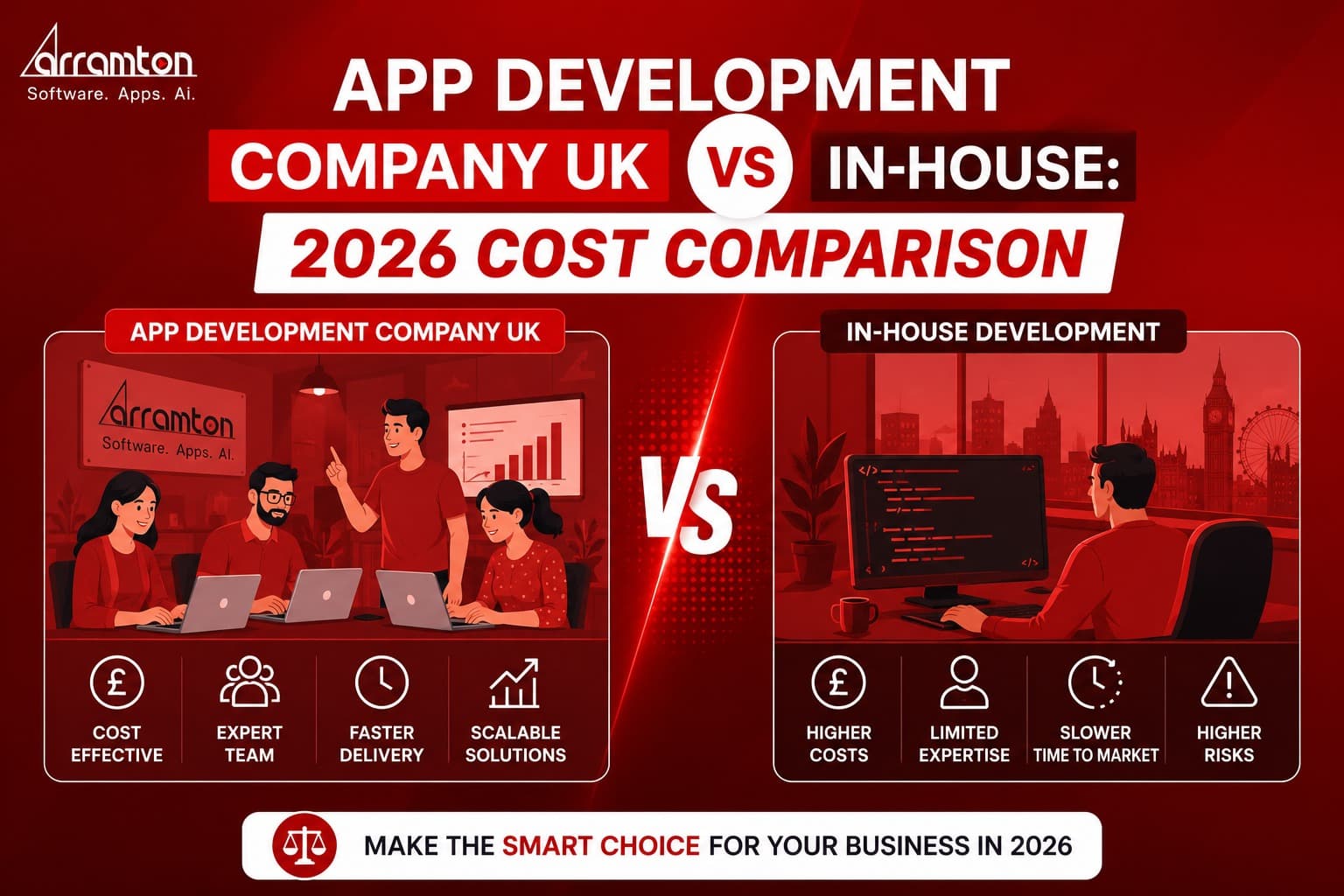
The Real Cost of Building an In-House Development Team UK
Building a dedicated in-house app development team in the UK is a significant investment, often underestimated by founders. Beyond base salaries, consider the full picture: employer National Insurance contributions, pension schemes, essential equipment, software licenses for development and collaboration tools, and the often-hefty recruitment fees. For a mid-level developer earning £70,000 annually, the true annual cost can easily climb to £95,000-£105,000 once these on-costs are factored in. This doesn't even account for the time and resources spent on onboarding new hires, which typically means 2-4 weeks of reduced productivity for the team and manager alike. A team of four developers, for instance, will require at least 20% of a senior technical manager's time for oversight and guidance.
Recruitment alone is a major hurdle. Agencies typically charge 15-25% of a developer's first-year salary for successful placement. This means a single senior developer hire could cost your business £10,000-£25,000 before they even write a line of code. Then there's the churn: UK developer attrition rates hover around 20-30% annually, meaning you're constantly recruiting and onboarding, bleeding cash and project momentum.
Initial setup costs can also be substantial. Beyond individual workstations, think about shared software licenses for IDEs, cloud services like AWS or Azure, project management tools, and communication platforms. These can easily add another £3,000-£8,000 per developer each year. If you're not prepared for these sustained overheads, an in-house team can quickly become a financial black hole. For a 3-person mobile team, your Year 1 expense, including salaries and setup, could realistically fall between £210,000 and £270,000.
Agency Cost: What You Actually Pay for a Development Company
Engaging an app development company in the UK typically involves a project-based fee or a retained service agreement. While the upfront figures might seem higher than a developer's salary, they bundle essential services that in-house teams require separate investment for. This includes project management, quality assurance, UI/UX design, DevOps, and direct access to a pool of specialised skills without the burden of individual hiring and management.
The true value an agency provides lies in its established processes, experienced teams, and a deep understanding of the development lifecycle. Costs can vary significantly based on the agency's location, reputation, and the complexity of your project. For an equivalent output to a 3-person in-house team, you might expect to pay £80,000-£150,000 annually through an agency or staff augmentation model. This figure is considerably lower than the fully-loaded in-house cost in the first two years.
Transparency is key when assessing agency costs. A reputable agency will break down their pricing, explaining what's included – from discovery workshops and wireframing to development, testing, and deployment support. It's crucial to scrutinise quotes for hidden extras or vague line items. A well-defined scope of work and a clear payment schedule are vital. Remember, the agency's pricing reflects their investment in infrastructure, training, and maintaining a high-calibre team ready to deliver.

Speed to Market: Agency vs In-House
For startups and businesses needing to launch quickly, the speed at which an app can be developed and deployed is paramount. An established app development company, particularly one with experience in your sector, often has a significant advantage here. They can immediately assemble a team with the right skillsets and leverage pre-existing frameworks and methodologies to accelerate development.
With an in-house team, the initial hiring phase can be a lengthy process, especially for specialised roles. Even once hired, a new team needs time to align on project goals, establish workflows, and build rapport. This ramp-up period can delay the project's start by weeks, if not months. An agency, conversely, can often kick off a project within a few weeks of signing a contract.
For UK businesses racing to capture market share, the speed an agency offers can be the difference between success and being outpaced by competitors; an agency can typically launch an MVP 2-4 months faster than a newly formed in-house team. This accelerated time-to-market allows for earlier user feedback, faster iteration, and quicker revenue generation, critical factors for early-stage companies.
Quality Control: Who Produces Better Code?
The perception that in-house teams inherently produce higher-quality code is often a myth. Quality is driven by skill, process, and a culture of excellence, not solely by who signs the paycheque. A top-tier app development agency invests heavily in attracting and retaining skilled developers, implementing rigorous testing procedures, and adhering to best practices in coding standards and documentation.
Agencies frequently work on diverse projects, exposing their developers to a wide range of challenges and technologies. This breadth of experience can lead to more robust and well-architected solutions. They also have dedicated QA teams and processes that ensure the software is thoroughly tested before deployment, catching bugs that might otherwise slip through an under-resourced in-house QA function.
However, the quality of code is directly tied to the specific team and agency you choose. A poorly managed agency can indeed churn out subpar code. Similarly, an in-house team lacking senior leadership or clear coding standards will struggle. The key differentiator often lies in the agency's accountability to a contract and a reputation that relies on delivering quality. For instance, using established CI/CD pipelines and automated testing frameworks are standard practice for many agencies, ensuring consistent quality.
Flexibility: Scaling Up and Down
One of the most significant advantages of partnering with an app development company is the inherent flexibility they offer. Startups and growing businesses experience fluctuating demands. You might need a large team for an initial build, followed by a smaller team for maintenance and feature additions. An agency can easily scale your development resources up or down as your needs change, a feat that's administratively complex and financially burdensome with an in-house team.
Bringing on new developers for an in-house team takes time and resources, involving recruitment, onboarding, and training. Conversely, if you need to downsize, managing layoffs and retaining talent becomes a difficult HR challenge. An agency can adjust team size on a project-by-project basis or even month-to-month, allowing you to pay only for the capacity you need at any given time.
This adaptability is crucial in the fast-moving tech landscape. For example, a London-based e-commerce platform might need to rapidly scale its development team to handle a seasonal peak or introduce a new feature set. An agency can provide those extra developers within weeks, ensuring deadlines are met. When demand subsides, the team can be reduced without the repercussions of internal restructuring. This agility allows businesses to remain lean and responsive.

IP, Knowledge Risk, and What Happens When People Leave
A common concern when working with external agencies is the protection of intellectual property (IP) and the risk of knowledge loss. Reputable agencies understand this and have robust legal frameworks in place to ensure all IP developed during the project belongs to you, the client. Contracts typically stipulate clear ownership of code, designs, and any other intellectual assets created.
However, the risk of knowledge loss is real, particularly regarding the undocumented 'why' behind certain technical decisions. While code is transferable, the intricate reasoning or strategic context can be harder to capture. To mitigate this, ensure your agency contract includes provisions for comprehensive documentation, ideally including weekly architecture notes. Furthermore, maintain your own internal technical documentation process and involve your own technical leads or advisors in code reviews throughout the engagement.
When individuals leave an in-house team, especially key members, it can create significant knowledge gaps. This is amplified by the high attrition rates common in the tech industry. Agencies, by contrast, manage this risk through team redundancy, knowledge sharing across projects, and structured handover processes. If a developer leaves an agency, the agency’s responsibility is to ensure continuity and knowledge transfer, often with minimal disruption to your project.
The Hybrid Model: What Most Successful UK Startups Actually Do
The hybrid model is rapidly becoming the preferred approach for many UK startups and scale-ups seeking to balance cost-efficiency, control, and agility. This model involves maintaining a small, core in-house technical team—often comprising a CTO, a technical lead, and a few senior developers—who oversee product strategy, architecture, and critical systems. This in-house core ensures IP protection and strategic direction are maintained internally.
Simultaneously, the company leverages staff augmentation or dedicated development teams from external partners to expand capacity for specific feature development, tackle complex technical challenges, or manage peak workloads. This allows them to tap into specialised skills or rapidly scale their team without the overhead of full-time hires. For instance, a Manchester-based SaaS company might have two in-house senior engineers defining the platform's roadmap, while a team of four augmented developers from an agency build out the mobile application based on their specifications.
This approach offers the best of both worlds: internal control over vision and architecture, combined with external flexibility and cost-effectiveness for execution. It provides a scalable, resilient development structure that adapts to business needs. It also ensures knowledge is retained within the company, while specific project execution can be highly efficient.
Decision Framework: When to Build In-House vs Agency vs Staff Aug
Deciding between building an in-house team, outsourcing to an agency, or using staff augmentation depends heavily on your current business stage, strategic goals, and available resources. If you're a pre-seed startup with a novel idea and limited capital, an agency or staff augmentation is usually the most prudent choice. It allows you to build your Minimum Viable Product (MVP) quickly, validate your market, and start generating revenue without the immediate commitment of permanent hires.
As your product gains traction and you secure further funding, you might consider building an in-house team for core product development, particularly for intellectual property that defines your company's unique value. This is often when the hybrid model becomes attractive. Staff augmentation remains valuable for scaling capacity for specific projects or bringing in niche expertise that's hard to find locally. For a US Series A fintech, for example, rapidly scaling the development team with augmented developers to meet aggressive product launch timelines is a common strategy before considering long-term hires.
For UK businesses, consider this: building an in-house team of three mobile developers costs between £210k-£270k in Year 1 alone. The same output via staff augmentation typically ranges from £80k-£150k. This stark difference highlights the financial viability of external partnerships for initial product development and scaling.

Calculate Your Build Cost
Calculating the true cost of app development requires looking beyond initial quotes and considering the total cost of ownership. For an in-house team, this includes salaries, benefits (pension, healthcare), National Insurance, equipment, software licenses, office space, recruitment fees, training, and management overhead. For a team of 3 developers in the UK, this could easily exceed £300,000 in the first year, including recruitment and setup costs. Over 3-5 years, if you avoid significant turnover, the cost per developer becomes more competitive, but the initial outlay and ongoing management are substantial.
Using an app development agency or staff augmentation partner generally offers a more predictable cost structure. For a project of similar scope, an agency might quote £80,000-£150,000 for the first year, which includes all the necessary expertise and infrastructure. Staff augmentation can be even more cost-effective, with hourly or daily rates providing clear expenditure. The primary benefit here is that these costs are directly tied to development output, rather than the fixed overheads of employment.
When comparing, remember to factor in the 'time to market' cost. A delay of six months could mean losing market share or missing a crucial funding round. The faster launch enabled by an agency can represent significant savings in terms of opportunity cost. Always request detailed breakdowns and compare apples to apples, considering not just the sticker price but the total value and speed delivered. If your goal is to launch an MVP and iterate rapidly, external partners often provide a clearer path to achieving that within budget.
FAQs:
Q1: Is it cheaper to build an in-house team or use an app development agency in the UK?
In-house is almost always more expensive in years 1-2, and becomes competitive in years 3-5 if the team is retained. Year 1 in-house costs for a 3-person mobile team: £210,000-£270,000 in salaries plus £50,000-£80,000 in recruitment costs, equipment, and benefits. Agency or staff augmentation for equivalent output: £80,000-£150,000. Year 3+ comparison shifts if you've retained the team and avoided turnover (UK developer attrition runs 20-30%/year, meaning average tenure is 3-4 years). The honest answer: use agency or staff augmentation to build your first product, prove revenue, then invest in building the in-house team with a proven product direction.
Q2: What are the hidden costs of building an in-house development team in the UK?
Often unbudgeted in-house costs: employer National Insurance (13.8% on salaries above £12,570), pension contributions (minimum 3% employer), equipment (£2,000-£4,000 per developer), software licences (development tools, cloud services, collaboration software — £3,000-£8,000/year per developer), recruitment fees (15-25% of first-year salary per hire — £10,000-£25,000 per developer), onboarding time (2-4 weeks reduced productivity from the wider team), and management overhead (a team of 4 developers needs at least 20% of a senior technical manager's time). Total employment cost for a £70,000 senior developer in the UK is approximately £95,000-£105,000 inclusive of all on-costs.
Q3: What happens to my app if an agency relationship ends?
With a well-structured agency contract: all code, documentation, and assets are transferred to you. You should have repository access throughout the engagement (not just at the end), and all code should be written and deployed in your infrastructure accounts (AWS, GCP, Azure under your login). The risk is knowledge loss — documentation rarely captures the reasoning behind architectural decisions. Mitigation: require weekly architecture notes as a deliverable alongside code, maintain your own internal technical documentation from the beginning, and ensure your team or a technical advisor is reviewing code throughout (not just at handover). The worst handovers happen when clients have had zero technical involvement during the project.
Q4: Can I switch from an agency to in-house development mid-product?
Yes — and this is a common and sensible progression. Typical pattern: agency builds V1 (MVP), product gets traction, first in-house technical hire (often a CTO or senior developer) transitions ownership, and ongoing development moves in-house with agency support on specific feature streams. Transition timeline: 2-3 months for a clean handover on a mid-complexity product. Keys to smooth transition: code quality matters enormously (well-structured, documented code takes 2-3 weeks to hand over; poor code can take months to understand), choosing an agency that writes code as if someone else will maintain it (they will), and having your incoming technical hire involved in the final 4-6 weeks of agency development.
Q5: What does the hybrid model look like in practice?
Hybrid (most common among UK scale-ups): small in-house team (1-3 senior developers, CTO or technical lead) manages product architecture and owns critical systems, with staff augmentation adding capacity for specific feature streams or peak delivery periods. Example: 2 in-house senior engineers own the core platform and set technical standards; 3 staff augmentation developers (from Arramton) work on the mobile app under in-house direction; output matches what a 5-person in-house team would produce at roughly 60% of the fully-loaded cost. This model gives you IP protection, technical knowledge retention, and quality control (in-house), combined with cost efficiency and scaling flexibility (staff augmentation).