Why Traditional App Development Timelines Are Broken
The days of app development taking six months or more are, for many projects, simply a relic of the past. Traditional approaches often suffer from bloated discovery phases, inefficient coding cycles, and protracted testing periods. This outdated model leads to spiralling costs, missed market windows, and significant founder frustration, particularly in the fast-moving UK tech scene.
Many UK startup founders and SME business owners find themselves caught in this cycle. They want to launch quickly, gather user feedback, and iterate, but lengthy timelines prevent this agility. The truth is, the perceived complexity of app creation often stems from the process itself, not the inherent difficulty of the app's functionality.
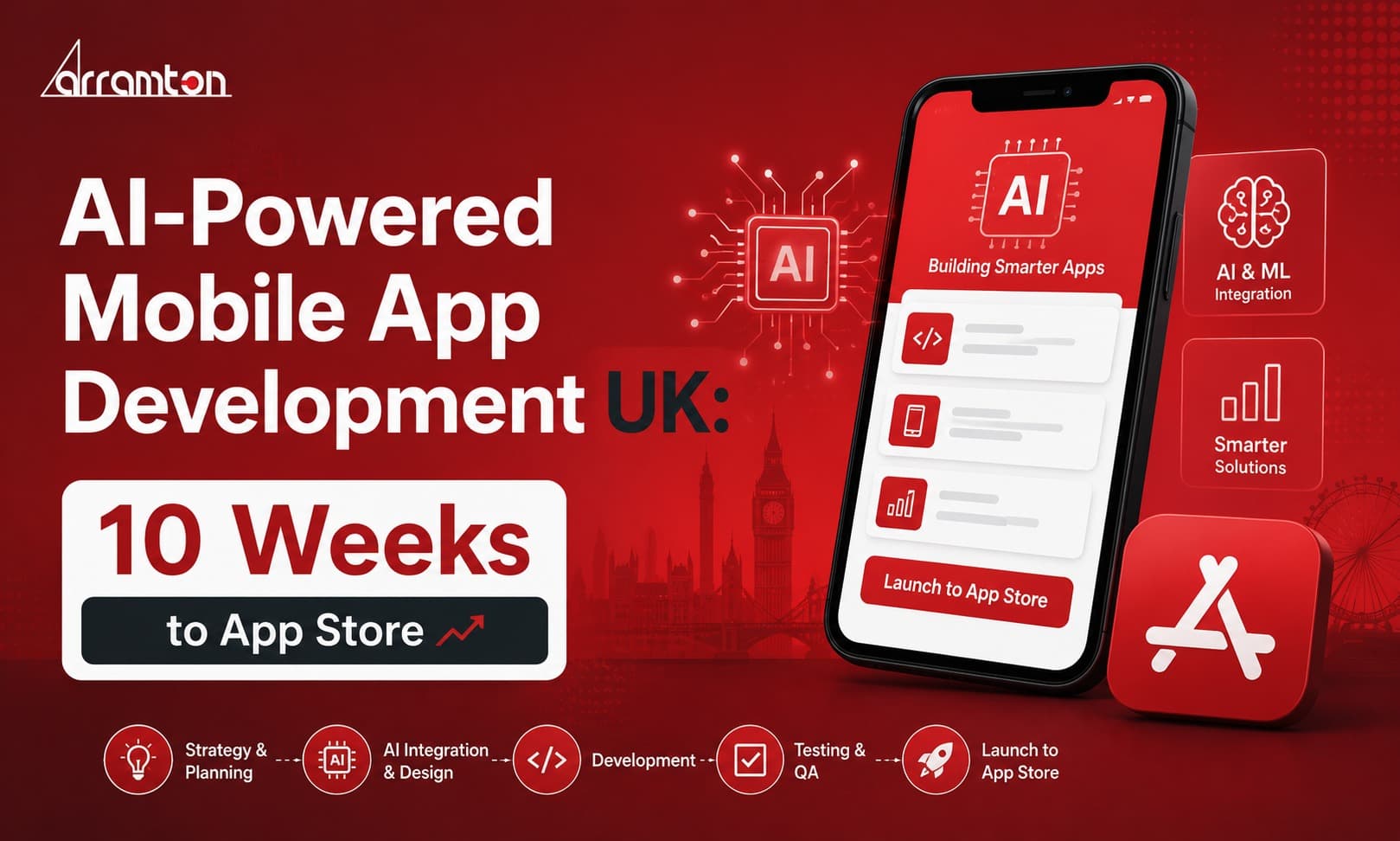
The 10-Week AI-Native App Development Timeline
Imagine launching your Minimum Viable Product (MVP) within a quarter. This isn't a pipe dream; it's achievable with a focused, AI-augmented approach. Our 10-week framework streamlines the entire process, from initial concept to App Store submission, leveraging AI tools at every critical juncture.
This isn't about cutting corners; it's about working smarter. By integrating AI, we automate repetitive tasks, accelerate decision-making, and enhance accuracy in design, development, and testing. This allows our teams to deliver high-quality applications on a schedule that respects your business's urgency.

Week 1-2: Discovery and Architecture With AI Planning Tools
The foundation of any successful app is a robust plan. In the first two weeks, we deep-dive into your project, defining user flows, mapping technical architecture, and establishing clear project scope. AI-powered tools assist in generating user journey diagrams, identifying potential technical challenges, and suggesting optimal tech stacks based on project requirements.
We'll use AI to analyse user personas and suggest features that align with market demand. This phase is critical for locking down the MVP scope, ensuring we build exactly what's needed to validate your idea. For a UK startup founder, clarity here means avoiding costly pivots later.
Week 3-6: AI-Augmented Development Sprint
With the blueprint set, we move into the core development phase. AI plays a significant role here, from generating boilerplate code and suggesting optimisations to assisting with complex algorithms. Our developers work in agile sprints, with daily stand-ups and weekly demos to keep you informed and involved.
AI tools can predict and flag potential bugs during coding, and even suggest code refactoring for better performance. This augmented approach means our dedicated developers can focus on the unique, complex aspects of your application, rather than reinventing standard components. This is where much of the speed is gained.
Week 7-8: AI-Assisted QA and Security Review
Quality Assurance and security are non-negotiable. During weeks seven and eight, AI enhances our testing protocols. We utilise AI-driven test case generation to ensure comprehensive coverage, alongside manual testing. Security vulnerabilities are automatically scanned for, flagging any potential risks before they become critical issues.
This AI-assisted approach ensures that even intricate functionalities are rigorously tested. It's about delivering an app that's not only functional but also secure and stable, building trust with your end-users. For a fintech app in London, this rigorous testing is paramount.
Week 9-10: App Store Submission and Launch
The final two weeks are dedicated to preparing your app for the App Store and Google Play. We handle the submission process, including optimising metadata, screenshots, and descriptions. AI tools can assist in generating compelling marketing copy and predicting review times, ensuring a smooth transition to launch.
We also include post-launch support to address any immediate issues that arise. The goal is to get your app into the hands of your target users swiftly and effectively. This accelerated timeline is particularly beneficial for US Series A founders who need to demonstrate traction.
What Can and Can't Be Compressed (Honest Guide)
AI-augmented development can dramatically shorten timelines, but it's vital to understand its limits. Core user flows, standard integrations, and well-defined APIs are prime candidates for compression. A logistics firm cutting reporting time from 9 hours to 90 minutes showcases this efficiency.
However, highly complex features requiring extensive research, unique third-party integrations with poor documentation, or apps demanding strict regulatory compliance (like advanced healthcare or fintech regulations) still require adequate time. Scope creep remains the enemy; a 10-week timeline is realistic for a well-scoped MVP, not an ever-expanding feature set. The key is to define the MVP tightly.
Case Study: How We Delivered a Fintech App in 9 Weeks
A London-based fintech startup approached us with a vision for a new payment processing application. They needed to hit the market within 10 weeks to capture a specific seasonal opportunity. The core requirements included user authentication, secure transaction handling, and integration with a primary payment gateway.
Using our AI-augmented process, we compressed the discovery and architecture phase into 10 days. The development sprint leveraged AI for code generation and automated testing. Rigorous QA, including AI-driven security scans, was completed in just under two weeks. The app was successfully submitted and approved in 9 weeks, perfectly aligning with the client's strategic launch window.

How to Get Started With Our 10-Week Process
Embarking on your app development journey with an accelerated timeline begins with a conversation. Understand your core problem, your target audience, and your MVP scope. Our team will guide you through the process, assessing feasibility and aligning expectations for a swift, successful launch.
If you're a UK startup founder or a US entrepreneur evaluating outsourcing, our process offers a clear, predictable path to market. We focus on delivering value rapidly, allowing you to test your hypotheses and begin scaling. At Arramton, we've seen this pattern across over 30 projects — founders who lock down their core MVP vision upfront are the ones who launch fastest and gain market share.
FAQs
Is a 10-week app timeline realistic for a complex app?
10 weeks is realistic for a well-scoped MVP — typically 3-5 core user flows, one platform (iOS or Android), and a clean API or existing backend. Complex apps with multiple user types, real-time features, third-party integrations, and compliance requirements (healthcare, fintech) typically require 14-20 weeks even with AI-augmented development. The honest answer: 10 weeks is achievable when scope is locked before development starts. Scope creep is the most common reason timelines extend. We address this with a fixed discovery sprint (Week 1-2) before any code is written.
What do I need to have ready before development can start?
The three things that most delay project starts: finalised user flows (which users do what, in what order), API documentation or backend access (if integrating with existing systems), and design direction (even rough brand guidelines). You don't need pixel-perfect designs before we start — our AI-assisted design process produces wireframes in the discovery sprint. But having clarity on the 3-5 core problems your app solves before kickoff cuts 1-2 weeks from the discovery phase.
What's included in the 10 weeks — design, development, testing?
Yes — all three. Our 10-week process covers: Week 1-2 (discovery, user flow mapping, technical architecture, wireframes), Week 3-6 (full stack development using AI-augmented sprints with daily stand-ups and weekly client demos), Week 7-8 (QA including AI-generated test suites, manual testing, performance testing, security review), Week 9 (App Store submission and review wait time), Week 10 (launch support, bug fixes, post-launch monitoring). Project management, client communication, and deployment are included throughout.
Can you build for both iOS and Android in 10 weeks?
Yes, using React Native or Flutter (cross-platform frameworks). Building natively in Swift and Kotlin separately would extend the timeline to 14-18 weeks for equivalent scope. For most UK startups, cross-platform is the right starting point — you reach both iOS and Android users simultaneously, the codebase is 85-90% shared, and the user experience is indistinguishable from native for standard app patterns. We only recommend separate native builds when the app requires deep platform-specific APIs (ARKit, HealthKit integration at a complex level) that cross-platform frameworks can't access efficiently.
What happens after the 10 weeks? Do you handle ongoing support?
Yes. Post-launch, we offer three ongoing engagement models: monthly retainer (a set number of developer hours for bug fixes, minor features, and updates — typically 40-80 hours/month), feature sprints (planned development cycles for larger new features, typically 4-6 week sprints), and staff augmentation (one or more dedicated developers embedded in your team for continuous development). Most clients move to a retainer or staff augmentation model after launch. We recommend starting with a 3-month post-launch retainer minimum to handle the inevitable user feedback and quick iterations.
Conclusion
The stark reality for many UK businesses is that they spend an average of £2,500 per month on manual tasks that could be automated by a well-built app.
This 10-week process is designed to minimise your time-to-market and allow for rapid validation. It’s about getting your app into users' hands efficiently. If you're evaluating partners for this kind of work, Arramton builds custom solutions for UK and US companies. Learn how our AI-augmented approach can accelerate your project.