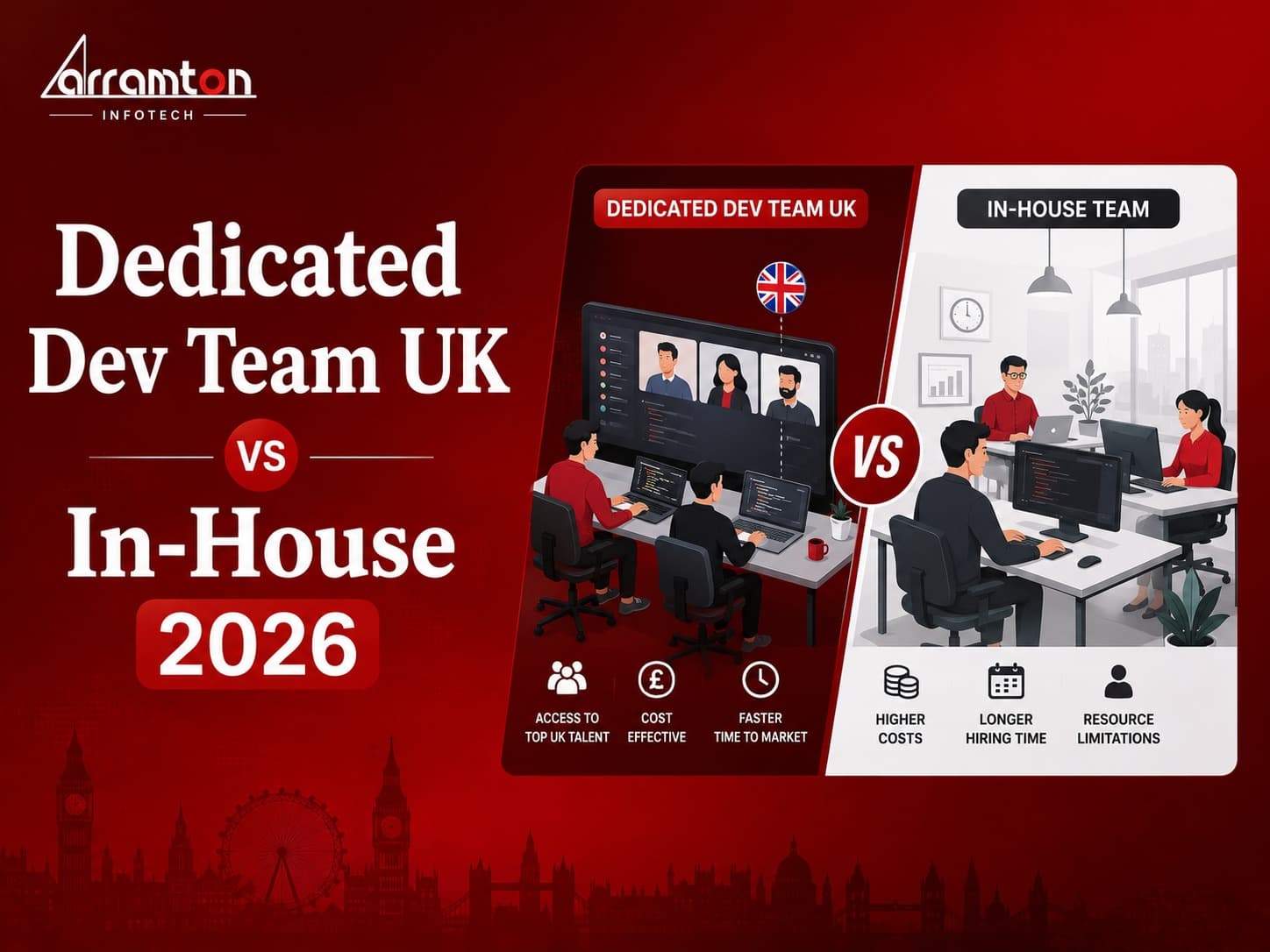
The Real Question UK Tech Leaders Are Asking in 2026
Many UK tech leaders in 2026 are grappling with a fundamental question: is it more effective and cost-efficient to build an in-house development team or engage a dedicated offshore team? The narrative often focuses solely on salary, but the true cost and operational implications are far more nuanced. This decision impacts not just your budget, but your speed to market, flexibility, and long-term talent retention. It's a strategic choice that warrants a clear-eyed analysis beyond the initial price tag.

True Cost of an In-House UK Developer (Beyond the Salary)
Hiring an in-house developer in the UK involves significant overheads that extend far beyond their advertised salary. For a mid-level developer earning £70,000, the total annual outlay can easily climb to £95,000–£110,000. This figure accounts for statutory contributions, employee benefits, and operational necessities that are often overlooked until the budget is finalised. Ignoring these oncosts is a common mistake that inflates expected expenses.
The Oncosts UK Companies Forget: NICs, Pension, Holiday, Equipment, Management
Employer National Insurance Contributions (NICs) alone add roughly 13.8% on salaries above the secondary threshold. Minimum pension contributions, typically 3% for the employer, add another layer. Factor in 28 days of paid holiday and statutory sick pay, and these costs accrue rapidly. Then there are the essentials: a company laptop, software licences, and the inevitable recruiter fees to find the talent in the first place. Don't forget the amortised cost of management time spent overseeing these individuals, which can amount to 15-20% of a developer's productive time.
Cost of a Dedicated Development Team in the UK 2026
Engaging a dedicated development team, often sourced from established outsourcing hubs like India, presents a more predictable cost structure. For a 5-person team comprising a tech lead, two senior developers, one mid-level developer, and a QA specialist, monthly costs typically range from £18,000 to £28,000. This rate is all-inclusive, eliminating the need for employers to manage NICs, pension schemes, holiday pay, recruitment fees, or equipment procurement. This all-in pricing offers considerable budget certainty.
Side-by-Side: 5-Person Dev Team, In-House vs. Dedicated Team
Let's compare a 5-person team directly. An in-house equivalent, based on the £70k mid-level developer example and scaling upwards for seniors and a lead, could easily incur annual costs of £420,000–£550,000. This translates to a monthly operational expense of £35,000–£48,000, once all oncosts are accounted for. In stark contrast, the dedicated team's £18,000–£28,000 monthly fee, or £216,000–£336,000 annually, represents a significant saving, often between 30-50%, while providing equivalent talent and capacity.
Speed to Productivity: In-House vs. Dedicated Team
Bringing an in-house developer up to full productivity can take months. They need onboarding, team integration, and often time to understand complex legacy systems or specific business logic. A dedicated team, particularly from a reputable provider, can often hit the ground running much faster. They usually come with established processes and a team dynamic already in place, ready to integrate with your project management tools and workflows. This rapid ramp-up is crucial for startups needing to iterate quickly.
Flexibility: Scaling Up and Down
One of the most significant advantages of a dedicated team is inherent flexibility. If your project scope shifts, or you need to scale your development capacity rapidly for a new feature launch, a staff augmentation partner can often adjust team composition or size within weeks. Replicating this agility with an in-house team is difficult; hiring takes time and resources, and layoffs are costly and damaging to morale. A dedicated team allows you to match your workforce precisely to current project demands.

Retention Risk: The Hidden Cost of In-House Tech Teams
Developer retention is a perennial challenge in the UK tech market. High staff turnover means constant recruitment costs, loss of institutional knowledge, and project delays. Replacing a single senior developer can cost tens of thousands of pounds in recruitment fees and lost productivity. For dedicated teams, the provider manages retention. While individual developers may rotate, the core team structure and the commitment to your project remain stable, mitigating this significant in-house risk.
Code Quality and Management Overhead Comparison
Concerns about code quality are common when considering external teams. However, quality is driven by process, not employment location. Established outsourcing partners implement rigorous code review standards, automated testing, and senior oversight. Their reputation depends on consistent delivery. The primary quality risks for dedicated teams are ensuring deep domain understanding during onboarding and maintaining continuity if team members rotate. For in-house teams, quality can be hampered by overloaded internal management who may lack deep technical oversight across multiple projects.
When In-House Wins
There are specific scenarios where building an in-house team makes undeniable sense. If your core product or service relies heavily on proprietary, deeply embedded intellectual property that cannot be shared externally, then in-house is the only option. It also suits companies with extremely stable, long-term development needs and a strong employer brand capable of attracting and retaining top-tier local talent without excessive recruitment expenditure. When culture and direct team cohesion are paramount and inflexible, in-house can be better.
When a Dedicated Team Wins
A dedicated team excels when speed, flexibility, cost-efficiency, and access to a broader talent pool are priorities. For startups needing to validate an MVP, scale rapidly for funding rounds, or manage fluctuating project demands, the benefits are clear. Companies in the UK that need to access specialised skills not readily available locally, or those aiming to reduce the significant administrative burden of UK employment law and HR, will find dedicated teams a more strategic choice. The ability to scale up or down without complex HR processes is a major differentiator.

The Break-Even Point: When Does In-House Become Cheaper?
Generally, once you require a team of eight or more developers consistently for over three years, the total cost of ownership for an in-house team begins to rival that of dedicated external teams. This calculation assumes you've optimised recruitment, minimised turnover, and can absorb the fixed overheads of office space, HR, and equipment across a larger headcount. Below this threshold, or for teams with variable workloads, the all-inclusive model of a dedicated team typically offers a superior return on investment and a more manageable operational footprint.
FAQs
What is the true fully-loaded cost of a mid-level software developer in the UK in 2026?
A mid-level developer with a £70,000 salary costs a UK company approximately £95,000–£110,000/year fully loaded. This includes: employer NICs (£9,100), pension minimum (£2,450), 28 days holiday oncost (£7,600), sick pay provision (£1,500), equipment and software licences (£2,500), recruiter fee (one-off, amortised: £3,000–£7,000), and management overhead. None of this includes office space if you're not fully remote, or training budget.
How much does a dedicated development team cost in the UK per month?
A typical 5-person dedicated team through a UK staff augmentation provider — 1 tech lead, 2 senior developers, 1 mid developer, 1 QA — costs £18,000–£28,000/month depending on seniority mix and supplier. This is a fixed all-inclusive rate with no employer NICs, no holiday pay, no pension, no recruitment fees, and no equipment costs. The equivalent in-house team would cost £35,000–£48,000/month fully loaded.
Does an in-house team always outperform a dedicated external team on quality?
No. Quality depends on the processes around the team — code review standards, testing culture, sprint discipline, architectural oversight — not employment status. Dedicated teams from established suppliers have often developed strong engineering cultures because their reputation depends on delivering quality consistently across clients. The key quality risks with dedicated teams are onboarding depth (do they understand your domain?) and continuity (what happens when a team member rotates off?).
What happens to a dedicated development team contract if my product pivot changes the tech requirements?
A well-structured dedicated team contract allows for role changes with notice — typically 30 days. If you pivot from React to Vue, or need to swap a mobile developer for a backend developer, a staff augmentation provider can rotate the team. This flexibility is one of the core advantages over in-house hiring, where changing a hire's role or making them redundant carries significant HR and legal overhead.
At what team size does hiring in-house become more cost-effective than a dedicated team?
Generally, once you need 8+ developers long-term (3+ years), in-house hiring starts to become cost-competitive — especially if you can build a strong employer brand, reduce recruiter dependency, and absorb the fixed costs of HR and equipment across a larger headcount. Below 8 people or for teams with variable workloads, dedicated teams almost always deliver better total cost of ownership.
Conclusion
The decision between an in-house team and a dedicated external one hinges on your specific business needs, growth stage, and strategic priorities. Understanding the full cost and operational impact is paramount. For many UK and US companies, a dedicated team offers a compelling blend of expertise, scalability, and financial predictability that is hard to match with traditional in-house hiring, especially at the early to mid-stages of product development. If you're evaluating partners for this kind of work, Arramton builds custom software solutions and provides dedicated developers for UK and US companies, helping them scale efficiently. Explore how Staff augmentation can provide the skilled talent you need, faster and more cost-effectively.