Why Flutter? Quick Case for Cross-Platform in 2026
Most businesses today recognise that a single native app for iOS and Android simply isn't enough to capture market share. Building two separate apps doubles your development time, increases maintenance overhead, and delays your go-to-market strategy. Flutter, Google's UI toolkit, offers a compelling alternative by enabling you to build natively compiled applications for mobile, web, and desktop from a single codebase. This cross-platform efficiency is crucial in 2026, especially for UK startups and SMEs aiming to reach a broad audience without disproportionately inflating their initial investment.
The core value proposition of Flutter is speed and cost-effectiveness. For a UK business operating on a tighter budget or facing aggressive launch timelines, Flutter allows for faster development cycles. It simplifies team management and reduces the need for specialised native developers for each platform. While not a universal panacea, its ability to deliver a consistent user experience across devices with a single development effort makes it a smart choice for many.

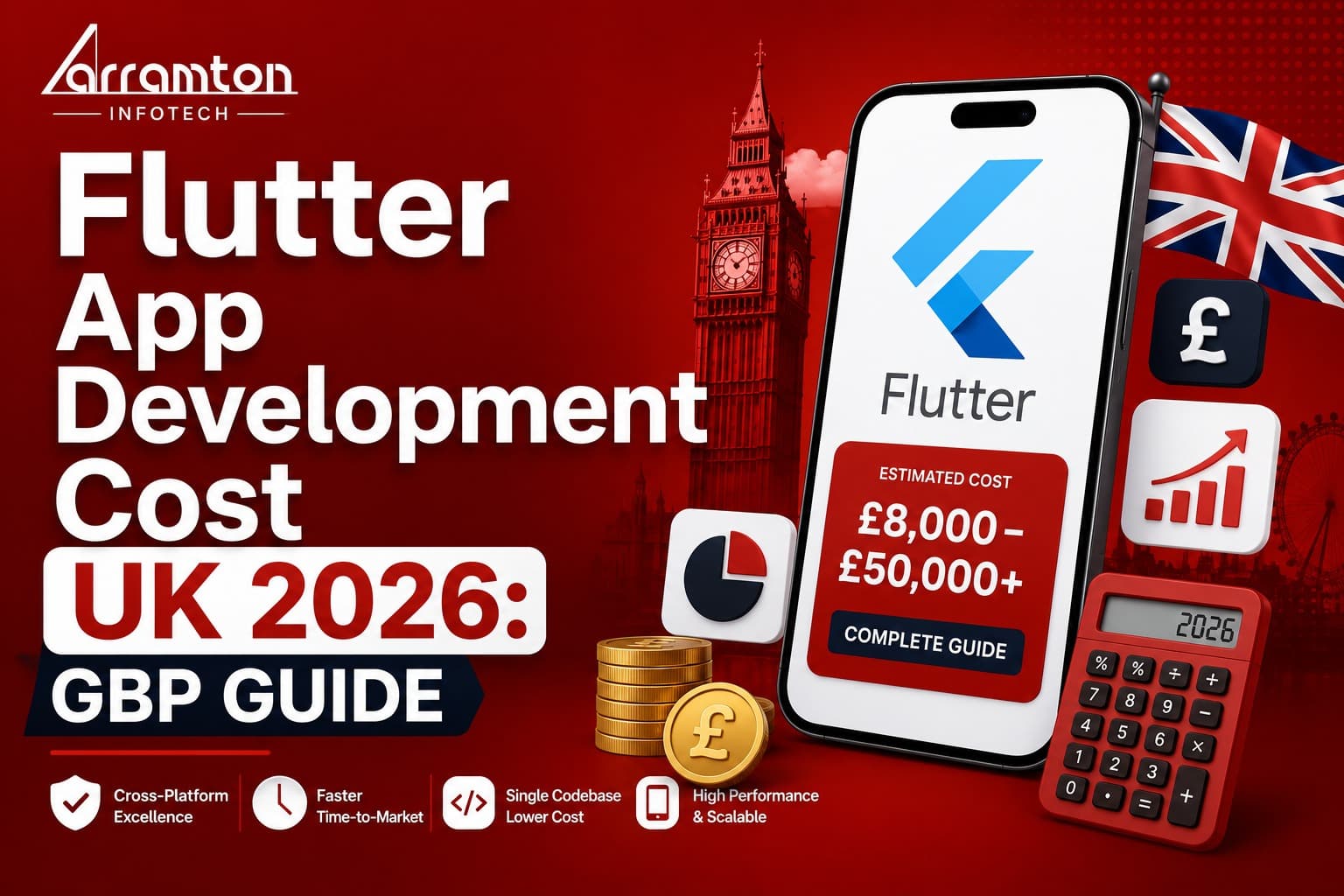
Flutter App Development Cost UK: Summary by App Type
Understanding the cost of Flutter app development in the UK requires looking beyond simple hourly rates. The complexity of your app is the primary driver, but factors like feature sets, integrations, backend requirements, and design sophistication all play a significant role. Here's a breakdown of typical investment ranges you can expect for Flutter projects in 2026, all in GBP.
Simple Flutter App (Brochure / Utility): £14,000–£28,000
At the lower end, you'll find apps that serve a singular purpose. Think digital brochures for a small business, simple utility tools like a calculator or a unit converter, or basic information display apps. These typically have minimal user interaction, no complex backend, and a straightforward UI design. They're great for establishing an online presence or offering a niche, uncomplicated service. At Arramton, we've seen projects like these launch in as little as 8 weeks.
Mid-Complexity Flutter App (Social / Booking / eCommerce): £28,000–£70,000
This category covers a wide range of functional applications that businesses commonly need. Examples include social networking apps with user profiles and feeds, booking platforms for services or appointments, or functional eCommerce apps allowing users to browse, select, and purchase products. These apps require robust backend integration for data management, user authentication, payment gateway integration, and often advanced UI/UX elements to ensure a smooth user experience. Building these kinds of apps necessitates careful planning of APIs and databases, increasing the overall development effort.
Complex Flutter App (Fintech / Healthcare / Marketplace): £70,000–£200,000+
The most significant investment is for highly complex applications. This includes fintech apps with secure payment processing and regulatory compliance (like FCA awareness), healthcare apps requiring data privacy (like DSPT compliance), or intricate marketplace platforms connecting multiple user types. These projects often involve real-time data synchronisation, advanced security protocols, AI/ML integrations, third-party API complexities, and demanding UI/UX. Regulatory adherence and rigorous testing are paramount, pushing timelines and costs upwards substantially.

What Drives the Cost of Flutter Development in the UK?
When evaluating Flutter app development costs in the UK, several key variables consistently influence the final quote. It's rarely just about the number of features; it's about the depth and complexity of how those features are implemented, and the environment they operate within.
The user interface (UI) and user experience (UX) design are critical. A basic, functional design is far less resource-intensive than a highly polished, custom, and animated interface. The more bespoke the design, the more time Flutter developers will spend on precise implementation and cross-platform consistency. Similarly, backend development and API integrations are major cost drivers. Building custom APIs, integrating with third-party services (like payment gateways, CRMs, or social logins), and setting up robust database structures require significant development hours.
Security and compliance are non-negotiable for many app types, particularly in sectors like fintech and healthcare. Implementing advanced security measures, encryption, and adhering to regulations like GDPR adds considerable complexity and cost. Furthermore, the need for ongoing support and maintenance, including bug fixes, performance optimisation, and feature updates, should be factored into the total cost of ownership from day one. At Arramton, we've seen projects where neglecting these aspects post-launch led to unforeseen expenses up to 50% of the initial build cost within the first year.
Flutter Developer Day Rates in the UK 2026
Developer rates are a direct indicator of market demand and skill level. In 2026, a mid-level Flutter developer working as a contractor in the UK typically commands between £400 and £600 per day. These professionals have a solid grasp of Flutter’s architecture, state management solutions like BLoC or Riverpod, and can independently implement moderately complex features. Senior Flutter developers, possessing extensive experience, a deeper understanding of platform nuances, and expertise in performance optimisation or complex architectural patterns, will charge higher rates, ranging from £600 to £850 per day.
These day rates reflect the UK's premium market. However, there's a more cost-effective alternative for UK businesses. Through staff augmentation models with offshore development centres, such as Arramton's team in Delhi, the equivalent daily rates for developers of the same calibre are significantly lower, typically falling between £250 and £400 per day. This model provides access to skilled Flutter developers without the premium associated with solely UK-based talent, making it an attractive option for budget-conscious firms.

UK Flutter Agency vs. Flutter Developer via Staff Augmentation: Cost Comparison
When you need Flutter development services in the UK, you generally have two primary routes: engaging a full-service UK-based agency or opting for staff augmentation. A UK Flutter agency will typically quote a project-based fee or a higher blended hourly rate that encompasses project management, UI/UX design, development, QA, and client communication, often ranging from £70–£150+ per hour for their services. This all-inclusive approach offers convenience and a single point of contact, but it comes at a premium.
Conversely, staff augmentation allows you to hire dedicated Flutter developers or even a full team through a UK-registered company that manages the offshore development talent. This model is usually priced based on the developer's all-in daily rate (including management, infrastructure, and support) which, as noted, is substantially lower, averaging £250–£400 per day per developer. This approach offers greater flexibility and significant cost savings, making it a preferred choice for many UK startups and SMEs looking to maximise their development budget without compromising on quality or expertise. Have you considered the long-term cost implications of agency overhead versus direct team integration?
Flutter vs React Native: Which Is Cheaper to Build in the UK?
For cross-platform mobile app development, Flutter and React Native are the two dominant players. In terms of raw development cost in the UK, they are often very comparable, with Flutter potentially holding a slight edge for certain projects. The primary factor influencing cost is not the framework itself, but the complexity of the app and the required expertise. Both frameworks allow for a single codebase, meaning you avoid the 35–50% cost increase typically associated with building two separate native apps.
Flutter's advantage often lies in its comprehensive SDK and tooling, which can sometimes streamline development and debugging processes, potentially leading to shorter development times for standard features. React Native, being JavaScript-based, can be attractive if your existing team has strong web development skills. However, Flutter's declarative UI approach and built-in widgets can accelerate UI development significantly. The real cost differentiator is the availability and rate of developers skilled in each technology. For a new project aiming for cost efficiency, Flutter often presents a slightly more direct path to a performant cross-platform application.
Hidden Costs UK Clients Miss (App Store Fees, Backend, Maintenance)
Beyond the initial development quote, UK clients often overlook several crucial costs that can significantly impact their app's total expenditure. The first is app store submission fees: Apple charges a £79 annual developer program fee, while Google Play has a one-time $25 registration fee. While seemingly minor, they are recurring or one-off requirements.
Backend infrastructure costs are a major area of oversight. If your app requires a server to store data, manage users, or process transactions, you'll incur ongoing expenses for cloud hosting (AWS, Azure, Google Cloud), database management, API maintenance, and scaling. These costs can grow substantially as your user base expands. Furthermore, post-launch maintenance and updates are essential. Bug fixes, security patches, OS compatibility updates, and adding new features require a dedicated budget. Neglecting maintenance can lead to app obsolescence and a poor user experience, as a Manchester-based property startup learned when their app’s performance degraded due to unaddressed backend scaling issues.

How to Get a Realistic Flutter Quote (What to Prepare)
Obtaining a realistic Flutter development quote requires thorough preparation and clear communication. Start by defining your app's core purpose and target audience. Draft a detailed feature list, categorising features by priority (must-have, should-have, nice-to-have) to help manage scope. Include any specific design requirements, branding guidelines, or required integrations with third-party services.
Prepare documentation for your backend needs, if applicable, including data structures and API functionalities. If you have existing infrastructure or data, document it. Provide a clear understanding of your budget expectations and timeline constraints. The more precise information you can provide to a potential development partner, the more accurate their quote will be. At Arramton, we typically require a detailed product brief, user flow diagrams, and a defined MVP scope to provide a firm Flutter app development quote for UK and US clients.
FAQs
Q1: Is Flutter cheaper to develop with than native iOS and Android?
Yes, meaningfully so. Flutter builds one codebase that runs on iOS and Android. Compared to two separate native builds, Flutter typically saves 35–50% in development cost. The trade-off is occasional platform-specific behaviour that requires extra work to handle, and some advanced native features (ARKit, specific Bluetooth protocols) that are more effort in Flutter than native.
Q2: What is the average Flutter developer day rate in the UK in 2026?
A mid-level Flutter developer on a contract in the UK charges £400–£600/day. Senior Flutter developers with platform-specific expertise and state management depth (Riverpod, BLoC) charge £600–£850/day. Through a staff augmentation arrangement with a UK-registered company delivering offshore, rates drop to £250–£400/day equivalent for the same seniority level.
Q3: How long does a Flutter app take to build in the UK?
A simple utility app: 8–12 weeks. A mid-complexity app with backend integration, payments, and user authentication: 14–22 weeks. A complex app (marketplace, healthcare, fintech with regulatory requirements): 24–40 weeks. These timelines assume a dedicated team — not shared across multiple projects.
Q4: Does Flutter work well for UK healthcare and fintech apps?
Yes. Flutter is widely used in UK healthcare app development (DSPT-compliant apps, patient portals) and fintech (FCA-aware payment and investment apps). The main considerations: Flutter's security model is solid, offline data encryption is straightforward to implement, and accessibility support (required for NHS and public sector apps) is good. You should audit your Flutter app against WCAG 2.2 before submission.
Q5: Can you update a Flutter app post-launch without going through the App Store?
Partially. Logic and UI updates can be delivered via server-driven UI patterns (fetching layout from an API). Code-level updates require App Store and Play Store review. For over-the-air (OTA) updates to Flutter specifically, options are more limited than React Native (which has Expo Updates). Plan your release cadence based on App Store review times — typically 24–72 hours for Apple, faster for Google.
The most common mistake UK businesses make is underestimating the ongoing cost of app maintenance and backend infrastructure, often adding 30-50% to the initial build cost annually. Planning for these hidden expenses from the outset is critical for long-term app success. If you're evaluating partners for building a cost-effective, high-quality Flutter app, Arramton builds robust software solutions for UK and US companies.