What Is a Multi-Agent AI System?
The UK's drive for efficiency means advanced automation is no longer a distant dream. Multi-Agent AI systems offer a significant leap, moving beyond single-point solutions. They're a network of specialised AI agents, each with a distinct role, working collaboratively to achieve complex goals. Think of it as an intelligent team rather than a solitary tool. This architecture is proving vital for UK enterprises aiming to streamline intricate workflows and unlock new operational efficiencies. This guide breaks down what you, as a UK CTO, need to know for 2026.
Single Agent vs. Multi-Agent: When Does the Complexity Pay Off?
A single AI agent, like a chatbot or a basic data analyser, excels at discrete tasks. However, its capabilities are confined. Multi-agent systems are designed for problems that require a breadth of skills, parallel processing, or intricate decision-making that a single AI can't handle. The complexity pays off when you're automating end-to-end processes, such as lead qualification involving CRM analysis, email drafting, and calendar scheduling, or complex data synthesis from multiple sources. For UK enterprises in 2026, the decision hinges on whether the workflow is inherently multifaceted. Simple, linear tasks remain best served by single agents; truly complex, dynamic operations demand the collaborative power of multiple agents.
At Arramton, we've observed this pattern across over 30 app and web development projects: teams often underestimate the value of orchestrating multiple AI functions. A single agent might handle reporting, but a multi-agent system can autonomously identify trends, draft initial strategy recommendations, and even populate a presentation draft.

Real UK Enterprise Use Cases That Justify Multi-Agent Architecture
UK businesses are finding tangible value in multi-agent AI. Consider a London-based financial services firm using a multi-agent system to automate compliance checks. One agent scans incoming documents for regulatory keywords, another cross-references them against internal policies, and a third flags discrepancies for human review. This drastically reduces manual effort and minimises risk. Similarly, e-commerce companies in Manchester are deploying agents to manage dynamic pricing based on competitor analysis, inventory levels, and real-time demand signals. A property tech startup in Leeds might use them for automated tenant screening, where one agent processes applications, another verifies references, and a third schedules viewings.
These aren't theoretical scenarios; they are operational shifts occurring now. The key is identifying processes that are data-intensive, iterative, and benefit from specialised, parallel analysis. Have you considered which of your own high-volume, multi-step processes could be transformed?
How Multi-Agent Systems Work: Orchestrator, Specialists, and Memory
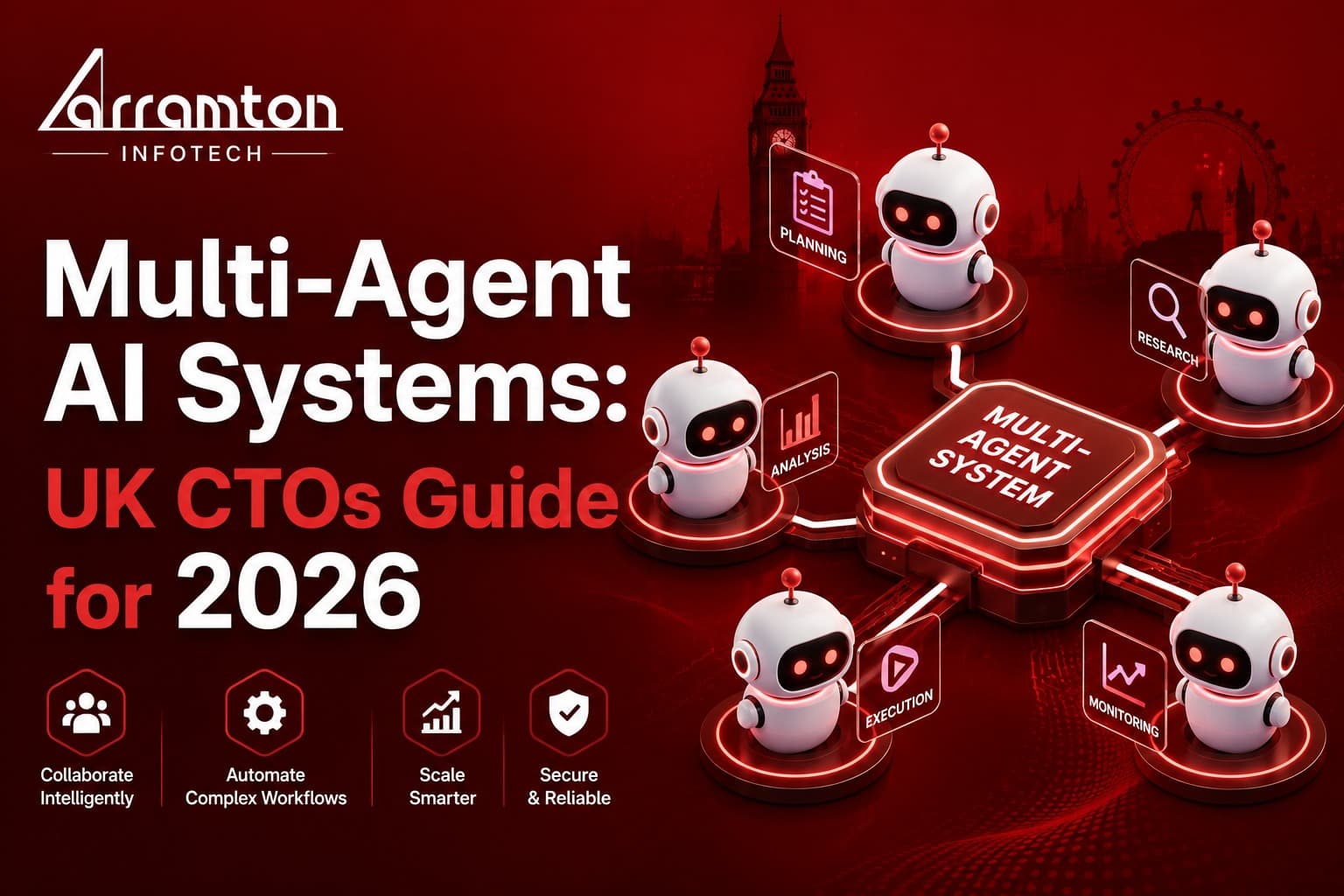
At its core, a multi-agent system functions through a clear division of labour and a centralised coordination mechanism. The 'Orchestrator' is the mastermind, directing the flow of tasks and decisions. It receives the initial request, delegates sub-tasks to the appropriate 'Specialist' agents, and synthesises their outputs. Specialist agents are designed for specific functions: one might be an expert in natural language processing for summarisation, another in data extraction from PDFs, a third in API interaction for external data retrieval. 'Memory' is crucial; it's the shared or individual knowledge base that agents access and contribute to, enabling them to learn from interactions and maintain context across complex workflows.
This structured approach ensures that each part of a larger problem is handled by the most capable component, leading to more accurate and efficient outcomes. For UK companies, this layered approach means greater control and traceability than with monolithic AI solutions.

The 3 Multi-Agent Frameworks UK Teams Are Actually Using (LangGraph, CrewAI, AutoGen)
When UK development teams select frameworks for building multi-agent systems, three stand out for their current adoption and capabilities in enterprise settings. LangGraph, an extension of LangChain, is favoured for complex, stateful agent workflows that require nuanced control over agent transitions and memory management, particularly in cyclical processes. CrewAI offers a more intuitive, role-based approach, making it excellent for collaborative tasks like content generation, data analysis, and research where agents have distinct personas and objectives. Microsoft AutoGen, part of its broader AI strategy, provides a flexible framework for creating conversational agents that can execute tasks, debug code, and integrate seamlessly with Azure services, making it a strong contender for existing Microsoft-centric enterprises.
The choice of framework depends heavily on the specific use case and your existing tech stack. A Leeds-based fintech evaluating these might lean towards LangGraph for its intricate data validation loops, while a London e-commerce scaling team might find CrewAI's agent collaboration more straightforward for marketing automation.
LangGraph
Ideal for complex, multi-step decision trees and iterative processes where state management is critical. It excels in scenarios requiring agents to revisit previous states to refine outputs.
CrewAI
Well-suited for tasks requiring agents to work in teams with defined roles. It simplifies the orchestration of agents for tasks like content creation, research synthesis, and complex data summarisation.
AutoGen
A powerful option for enterprise integration, enabling agents to communicate and execute tasks through flexible conversations. Its strength lies in code generation, debugging, and integration with cloud platforms like Azure.
What Does a Multi-Agent System Cost to Build in the UK?
Estimating the cost of a multi-agent AI system in the UK requires a granular view of the scope. A focused project, perhaps automating a specific internal workflow with 3–5 specialised agents and using your existing data, typically falls between £80,000 and £200,000. This cost covers discovery, architecture design, development, integration, and initial testing. More ambitious, enterprise-wide autonomous systems involving external data integrations, stringent compliance architectures, and bespoke AI model training can escalate significantly, ranging from £300,000 to £600,000 or more. Most UK enterprise teams in 2026 are wisely starting with a pilot project, budgeting £30,000–£60,000 to validate the architecture and demonstrate ROI before committing to a full-scale deployment.
This upfront investment is crucial for de-risking a complex technological adoption. For a founder in Manchester evaluating this, a pilot ensures the chosen framework and agent interactions deliver the expected results before scaling.
GDPR and Data Governance in Multi-Agent AI: What UK Teams Must Architect In
Data governance, particularly GDPR compliance, is paramount and introduces architectural considerations for multi-agent systems. Every data transfer between agents, if it involves personal data, is a potential GDPR event. Therefore, robust architecture must include data minimisation principles at each step, ensuring agents only access what's strictly necessary. Comprehensive logging is essential to track precisely what data each agent accessed and processed, facilitating audits and transparency. Mechanisms to fulfil data subject access requests must extend to all agent memory stores. Furthermore, a thorough Data Protection Impact Assessment (DPIA) is non-negotiable for any high-risk processing activities. This is not an afterthought; it requires deliberate architectural planning from the outset, which adds to the overall cost and development time.
Failure to architect these controls from day one can lead to significant compliance breaches and penalties, making proactive design critical for any UK enterprise.

Build vs. Buy: Off-the-Shelf Platforms vs. Custom Multi-Agent Systems
The decision to build a custom multi-agent system or leverage off-the-shelf platforms involves a trade-off between speed and flexibility. Off-the-shelf solutions offer quicker deployment for common use cases, such as basic customer support automation or content generation. They're often more budget-friendly initially and require less in-house expertise. However, these platforms can be restrictive, lacking the specific customisations needed for unique business processes or integrations with legacy UK systems. Building a custom system, while requiring a larger upfront investment and longer timeline, provides complete control. It allows for tailored agent specialisations, bespoke memory architectures, and seamless integration with your unique data sources and existing infrastructure. For most UK enterprises with complex, proprietary workflows, a custom build, often starting with a pilot, offers the most sustainable and scalable long-term solution.
The 4 Most Common Mistakes UK CTOs Make When Scoping Multi-Agent Projects
Scoping a multi-agent AI project is fraught with potential pitfalls. A common mistake is **underestimating the complexity of agent communication and orchestration**. Teams often focus on individual agent capabilities, forgetting that seamless interaction is the true challenge. Secondly, **failing to define clear success metrics** from the outset means projects drift without measurable outcomes. Thirdly, **neglecting data governance and privacy requirements** (like GDPR) during the initial design phase, leading to costly re-architecting later. Finally, **choosing the wrong framework for the use case**—a common error when teams adopt popular tools without understanding their limitations. For instance, using a conversational agent framework for a highly structured data processing task. These oversights can derail even the most promising AI initiatives.
How to Run a Pilot Before Committing Full Budget
A pilot project is your essential de-risking strategy for multi-agent AI. Begin by identifying a single, well-defined business problem that a multi-agent system can demonstrably solve. Focus on a limited scope with a clear, measurable outcome—e.g., automating a specific reporting task or a segment of customer inquiry triage. Select a suitable framework (LangGraph, CrewAI, AutoGen) and assemble a small, focused development team. Set clear KPIs for the pilot, such as time saved, accuracy improvement, or cost reduction. Crucially, ensure the pilot includes essential governance checks, even in a simplified form. A successful pilot, typically costing £30,000–£60,000, provides invaluable data, validates the chosen approach, and builds stakeholder confidence for a full-scale rollout.
This methodical approach ensures that you're not investing significant capital into a solution that doesn't align with your strategic objectives. It allows for agile iteration based on real-world performance.

Timeline: From Discovery to Production-Ready Multi-Agent System
Bringing a multi-agent AI system into production is a phased journey. The **Discovery and Scoping** phase typically takes 2–4 weeks, defining the problem, objectives, and initial architecture. This is followed by a **Pilot Development** phase, lasting 6–10 weeks, where a subset of the system is built and tested. Assuming a successful pilot, the **Full Development and Integration** phase can take 3–6 months, depending on complexity, data sources, and required integrations. **Testing and Validation**, including UAT and security reviews, adds another 4–8 weeks. Finally, **Deployment and Iteration** is an ongoing process, with initial production rollout taking 1–2 weeks, followed by continuous monitoring and refinement. In total, from initial concept to a production-ready system for a complex workflow, expect 6 to 12 months.
How to Run a Pilot Before Committing Full Budget
A pilot project is your essential de-risking strategy for multi-agent AI. Begin by identifying a single, well-defined business problem that a multi-agent system can demonstrably solve. Focus on a limited scope with a clear, measurable outcome—e.g., automating a specific reporting task or a segment of customer inquiry triage. Select a suitable framework (LangGraph, CrewAI, AutoGen) and assemble a small, focused development team. Set clear KPIs for the pilot, such as time saved, accuracy improvement, or cost reduction. Crucially, ensure the pilot includes essential governance checks, even in a simplified form. A successful pilot, typically costing £30,000–£60,000, provides invaluable data, validates the chosen approach, and builds stakeholder confidence for a full-scale rollout.
This methodical approach ensures that you're not investing significant capital into a solution that doesn't align with your strategic objectives. It allows for agile iteration based on real-world performance.
FAQ
What is a multi-agent AI system in simple terms?
It's a setup where multiple specialised AI agents work together — each handling a specific task — coordinated by an orchestrator agent. Think of it like a team: one agent reads your CRM, one drafts emails, one checks availability, one sends. The orchestrator decides what happens next based on each agent's output.
Are multi-agent systems ready for production in UK enterprises in 2026?
Yes, but selectively. Multi-agent systems are production-ready for well-scoped, structured workflows — document processing, sales automation, support triage. They still require careful guardrails for high-stakes decisions in regulated sectors (finance, healthcare). Most UK enterprise teams are running pilots in 2026, not full-scale deployments.
What frameworks do UK developers use to build multi-agent AI systems?
The three most common in UK enterprise projects are LangGraph (for stateful, cyclical agent workflows), CrewAI (role-based agent teams, good for document and research tasks), and Microsoft AutoGen (strong for enterprise integration with Azure). Framework choice depends on the use case and your existing infrastructure.
How is GDPR handled in multi-agent AI systems?
Each data pass between agents is a potential GDPR event if it involves personal data. You need: data minimisation at each step, clear logging of what data each agent accessed, a mechanism for data subject requests to reach all agent memory stores, and DPIAs for high-risk processing. This adds architectural complexity — budget for it upfront.
What does it cost to build a multi-agent AI system for a UK enterprise?
Costs vary significantly by scope. A focused multi-agent workflow (3–5 agents, internal data only) typically runs £80,000–£200,000. Full enterprise autonomous systems with external integrations, compliance architecture, and custom models can reach £300,000–£600,000+. Most UK teams start with a £30,000–£60,000 pilot to validate the architecture.
The journey to adopting multi-agent AI systems is complex but increasingly vital for UK enterprises seeking a competitive edge. While the potential for automation and efficiency gains is immense, careful planning around architecture, data governance, and team capabilities is crucial. The most successful implementations in 2026 will be those that start with focused pilots, rigorously define success metrics, and leverage the right frameworks for their specific challenges.
If you're evaluating partners for building robust, compliant multi-agent AI solutions, Arramton delivers AI development services for UK and US companies, focusing on practical, high-ROI applications.