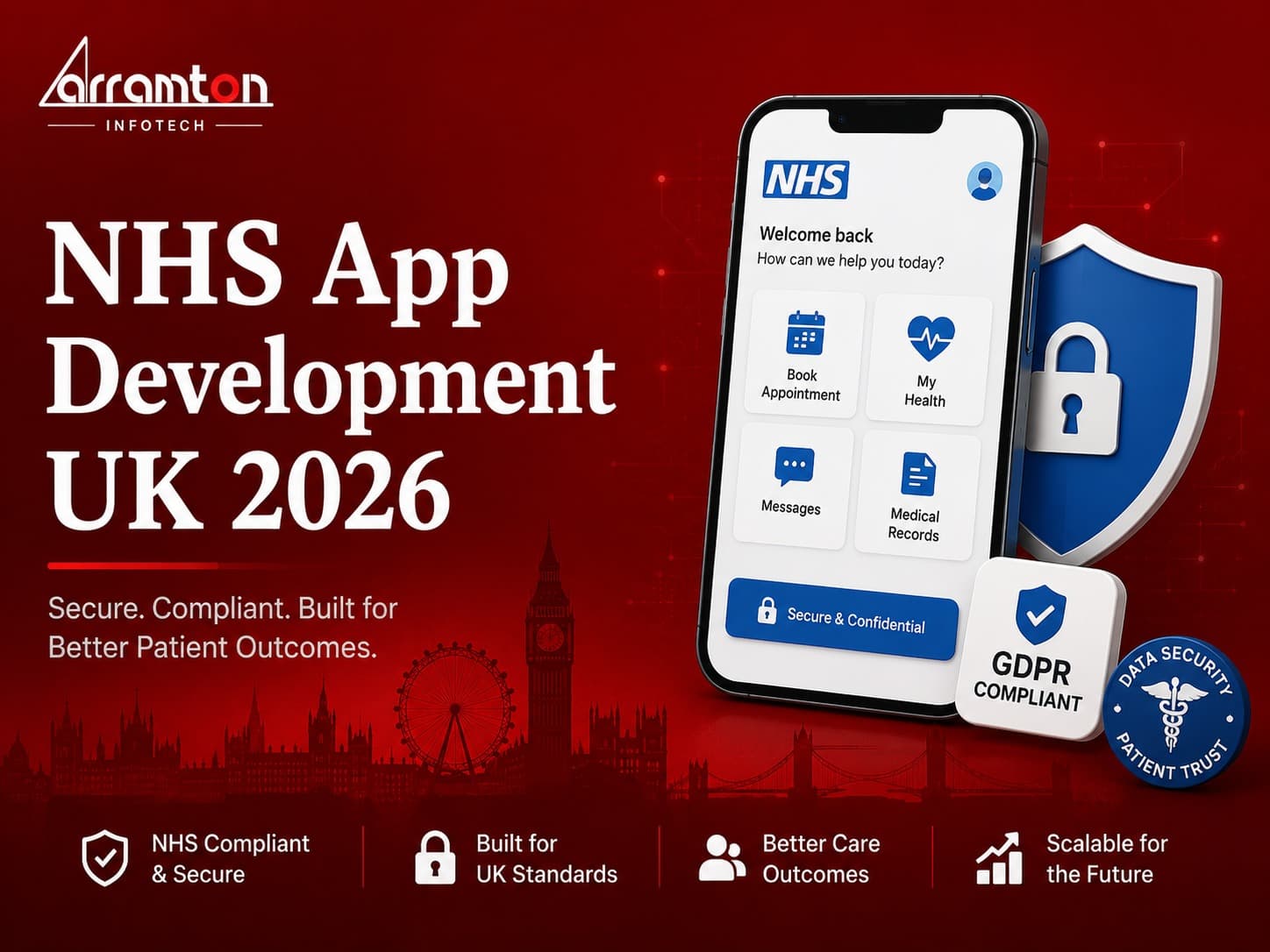
NHS app development in the UK comes with a unique set of regulatory hurdles. Unlike many other sectors, building software destined for the National Health Service means navigating stringent data security, technology assessment, and medical device regulations. Get this wrong, and your app won't just fail to launch; it could land you in serious legal trouble. This guide breaks down the essential UK healthcare app development requirements for 2026, including DSPT, DTAC, and CQC registration, so you can build with confidence.

Why Healthcare App Development in the UK Is Different From Any Other Sector
Developing an app for the NHS or a private healthcare provider in the UK isn't like building a consumer app or a SaaS platform. The stakes are immeasurably higher. Patient safety, data privacy, and clinical efficacy are paramount. This sector operates under a dense web of regulations designed to protect one of the nation's most sensitive datasets and ensure the highest standards of care. Ignoring these frameworks from the outset is a costly mistake; compliance isn't an afterthought, it's the bedrock of any successful healthcare technology project in the UK.
This intense regulatory environment means longer development cycles, more rigorous testing, and a significantly higher development cost compared to non-regulated sectors. Budgets and timelines must account for this complexity from the initial discovery phase. Failure to do so often results in costly rework, missed market opportunities, and a loss of investor confidence.
The NHS Digital Toolkit: What Is It and Does Your App Need It?
The NHS Digital Toolkit, often referred to as the Digital Technology Assessment Criteria (DTAC), is a crucial framework for any digital health technology looking to be procured by NHS England, Integrated Care Systems (ICSs), or NHS Trusts. It's essentially the gatekeeper, ensuring that the technology being considered is safe, secure, effective, and interoperable with existing NHS systems. It's not a single document but a set of criteria that your app's architecture, development process, and operational procedures must meet.
If your intention is to sell your healthcare app directly to the NHS, or to have it endorsed and used within NHS procurement channels, then understanding and preparing for DTAC assessment is non-negotiable. While not strictly mandatory for apps sold directly to consumers, achieving DTAC compliance voluntarily can significantly enhance trust and open doors to future NHS integration or sales.
DSPT (Data Security and Protection Toolkit): Requirements for App Developers
The Data Security and Protection Toolkit (DSPT) is an annual self-assessment and assurance process for organisations that handle NHS patient data. It's managed by NHS England and ensures that organisations meet the required data security standards. For app developers, this means demonstrating robust data handling policies, secure coding practices, and appropriate access controls, especially if your app will be storing, processing, or transmitting patient identifiable information (PII) or sensitive health data.
Completing the DSPT is a prerequisite for many data sharing agreements with NHS bodies. Developers must accurately reflect their organisation's adherence to the NHS's data security standards. This includes conducting a Data Protection Impact Assessment (DPIA) and ensuring all relevant staff undergo mandatory data security training. For many NHS procurement opportunities, achieving 'Standards Met' is the minimum requirement.

DTAC (Digital Technology Assessment Criteria): The NHS App Gatekeeping Framework
DTAC is the primary benchmark used by NHS procurement bodies to evaluate digital health technologies. It's designed to give commissioners confidence that a product is safe, secure, and fit for purpose within the complex NHS ecosystem. It covers a broad range of areas, from clinical safety and cybersecurity to data privacy and accessibility. The assessment process itself is carried out by accredited DTAC assessors.
The criteria are comprehensive and often require evidence of your development lifecycle, security architecture, and ongoing operational procedures. Successfully navigating DTAC involves a deep understanding of both technical implementation and the NHS's operational realities. It's not just about building a functional app; it's about building a trustworthy and compliant digital health solution.
DTAC's 5 Assessment Areas: What Developers Are Evaluated On
DTAC assessment is structured into five key areas. Firstly, Clinical Safety ensures the app doesn't pose a risk to patients and functions as intended from a clinical perspective. Secondly, Cyber Security scrutinises your data protection measures, vulnerability management, and incident response capabilities, aligning with standards like the DSPT. Thirdly, Usability and Accessibility guarantees the app is easy to use for its intended audience, meeting standards like WCAG 2.2 for inclusivity.
Fourthly, Interoperability and Data Standards checks if your app can effectively share data with other NHS systems using recognised standards like FHIR. Finally, Service Management and Support assesses your organisation's ability to provide ongoing maintenance, updates, and reliable support for the application. Each area requires meticulous documentation and demonstrable evidence of compliance.
CQC Registration: When Does Your App Become a Regulated Medical Device?
The Care Quality Commission (CQC) is responsible for regulating health and social care services in England. Your app might fall under CQC’s remit if it is classified as a 'medical device' or 'Software as a Medical Device' (SaMD). Generally, if software is intended to be used for a medical purpose — such as diagnosis, prevention, monitoring, treatment, or prediction of disease — it is considered a medical device.
The key determinant for CQC registration is whether your software directly supports or makes a clinical decision. A simple appointment booking app for a GP surgery likely wouldn't require CQC registration. However, a symptom checker that diagnoses a condition, or software that monitors vital signs and alerts clinicians to critical changes, almost certainly would. Understanding this distinction is critical for compliance.
UK MDR 2002 and Software as a Medical Device (SaMD): Where the Line Is
The UK Medical Devices Regulations 2002 (UK MDR 2002), as amended, governs medical devices, including SaMD. The Medicines and Healthcare products Regulatory Agency (MHRA) oversees these regulations. Guidance from the MHRA clarifies that software performing diagnostic functions, aiding in treatment planning, or influencing clinical decision-making is generally considered a medical device.
The classification of SaMD dictates the conformity assessment procedures required before it can be placed on the market. This can range from self-certification for lower-risk devices to requiring Notified Body involvement for higher-risk classifications. The UK MDR 2002 framework is complex, and early consultation with regulatory experts is advisable to correctly classify your SaMD and ensure you follow the appropriate regulatory pathway.

Data Residency: Where Can NHS Patient Data Be Stored?
NHS patient data is highly sensitive and subject to strict data residency requirements. Generally, this data must be stored within the UK or the European Economic Area (EEA). Storing NHS patient data on servers located in the United States, even if managed by major cloud providers like AWS, Azure, or GCP, introduces significant compliance challenges under UK GDPR and the NHS's own stringent data security mandates.
To comply, healthcare app developers must utilise UK or EEA-based cloud regions for their production environments. For instance, using AWS's eu-west-2 (London) region, Azure's UK South region, or Google Cloud's europe-west2 (London) region ensures data remains within compliant geographical boundaries. This decision impacts your infrastructure choices and can influence your overall cloud strategy.
Accessibility: WCAG 2.2 and the Public Sector Bodies Accessibility Regulations
For any application intended for use by the public sector, including NHS apps, adherence to accessibility standards is mandatory. The Public Sector Bodies Accessibility Regulations 2018 require that public sector websites and apps are accessible to all users, regardless of their abilities. This aligns with the Web Content Accessibility Guidelines (WCAG) 2.2 Level AA standard.
Developers must ensure their app's user interface is navigable using assistive technologies like screen readers, that colour contrast is sufficient, and that all functionality is available via keyboard input. Incorporating accessibility from the design phase, rather than attempting to bolt it on later, is far more efficient and cost-effective. It also ensures a better user experience for a wider range of patients and healthcare professionals.
NHS App Architecture Checklist: What to Build In Before You Submit
When designing your NHS app's architecture, prioritise security, scalability, and compliance from day one. Key considerations include:
- Secure Authentication and Authorisation: Implement robust user verification and role-based access control to ensure only authorised personnel can access sensitive data.
- Data Encryption: Encrypt all patient data both in transit (e.g., using TLS 1.2+) and at rest.
- Audit Trails: Maintain comprehensive logs of all data access and modifications for accountability and troubleshooting.
- API Security: If using APIs, ensure they are well-documented, authenticated, and authorised.
- Scalable Cloud Infrastructure: Design for growth using compliant cloud services (AWS, Azure, GCP) in UK/EEA regions.
- Regular Vulnerability Scanning: Integrate automated tools to identify and address security weaknesses throughout the development lifecycle.
- Compliance by Design: Embed DSPT, GDPR, and relevant NHS guidelines into the architecture itself.
At Arramton, we've integrated these architectural principles across over 20 healthcare app projects, ensuring that security and compliance are built-in, not bolted-on, dramatically reducing the risk of costly post-development fixes.
Timeline to NHS Procurement: What Founders Underestimate
Many founders underestimate the time required to get an app through the NHS procurement and assessment process. Beyond the development itself, you must factor in time for:
- DSPT Completion: This can take several weeks to months, depending on your organisation's readiness and data handling maturity.
- DPIA and Risk Assessments: Thoroughly documenting data protection risks is time-consuming.
- Penetration Testing: Independent security testing is mandatory and requires scheduling.
- Accessibility Audits: Ensuring WCAG 2.2 compliance often involves specialised testing.
- DTAC Assessment: The formal assessment process with an accredited assessor can take several weeks, including report writing and potential re-assessments.
- NHS Procurement Cycles: The actual procurement process within an NHS Trust or ICS can be lengthy, involving tenders and evaluations.
For a complex clinical support tool, the entire journey from initial development to being procurement-ready can easily extend to 12–18 months. Founders often underestimate the 'getting to market' phase, assuming development time is the only significant factor.

Cost of DTAC-Compliant Healthcare App Development in the UK
Building an NHS-compliant healthcare app in the UK is inherently more expensive than a comparable consumer application. You can expect costs to be 40–60% higher due to the extensive regulatory requirements, rigorous testing, and specialised expertise needed. A DTAC-ready patient-facing app or clinical support tool typically falls within the £60,000–£180,000 range, depending heavily on its complexity, features, and the depth of its clinical integration.
Beyond core development, allocate an additional £15,000–£30,000 for crucial compliance activities: preparing DSPT documentation, conducting thorough DPIAs, engaging third-party penetration testers, and performing comprehensive accessibility audits. The final hurdle, the DTAC assessment itself performed by an accredited assessor, will add another £5,000–£15,000 to your budget. While a significant investment, this cost is essential for market access and patient safety.
FAQ
Does every NHS-facing app need DTAC assessment?
DTAC assessment is required for any digital health technology that NHS England, an ICS, or an NHS Trust wants to procure. If you are selling directly to patients or clinicians outside of NHS procurement (e.g. a direct-to-consumer health app), DTAC is not mandatory — but many B2C health apps voluntarily seek DTAC compliance to build trust and open future NHS sales channels.
What is the DSPT and which organisations need to complete it?
The Data Security and Protection Toolkit is an NHS England framework that organisations use to demonstrate compliance with data security standards. Any organisation accessing NHS patient data — including app developers with NHS data sharing agreements — must complete the DSPT annually. Completion at 'Standards Met' level is typically required before NHS data can be shared.
When does an NHS app become a regulated medical device under UK law?
Software is a medical device (SaMD) if it is intended to be used for a medical purpose — diagnosis, prevention, monitoring, treatment, or prediction of a disease or condition. The MHRA's guidance from 2021 and updated in 2024 draws the line at software that makes or supports a clinical decision. A symptom checker that routes to a GP is likely a medical device. A booking app for GP appointments is not.
Where must NHS patient data be stored — can it be on US cloud servers?
NHS data should be stored within the UK or EEA. Storing NHS patient data on US-based servers (even AWS, Azure, or GCP US regions) without additional safeguards creates data transfer compliance issues under UK GDPR and the NHS's own data security standards. Use UK or EEA cloud regions (AWS eu-west-2 London, Azure UK South, GCP europe-west2 London) for production data.
How much does it cost to build an NHS-compliant app in the UK?
More than a comparable consumer app — typically 40–60% more due to compliance requirements. A DTAC-ready clinical support tool or patient-facing NHS app typically costs £60,000–£180,000 depending on complexity. Add £15,000–£30,000 for DSPT documentation, DPIA preparation, penetration testing, and accessibility audit. DTAC assessment itself (done by a DTAC-accredited assessor) adds £5,000–£15,000.
Conclusion
Navigating the regulatory landscape for NHS app development in the UK is complex but achievable with the right approach. Understanding DSPT, DTAC, CQC, and data residency requirements from the outset is not just about compliance; it's about building trust and ensuring patient safety. The initial investment in rigorous development, testing, and compliance preparation will pay dividends in market access and long-term success within the healthcare sector.
For founders evaluating partners to build these critical applications, Arramton specialises in creating secure, compliant, and high-performing healthcare solutions for UK and US organisations. Explore our approach to building regulated software and ensure your next healthcare app meets every standard.