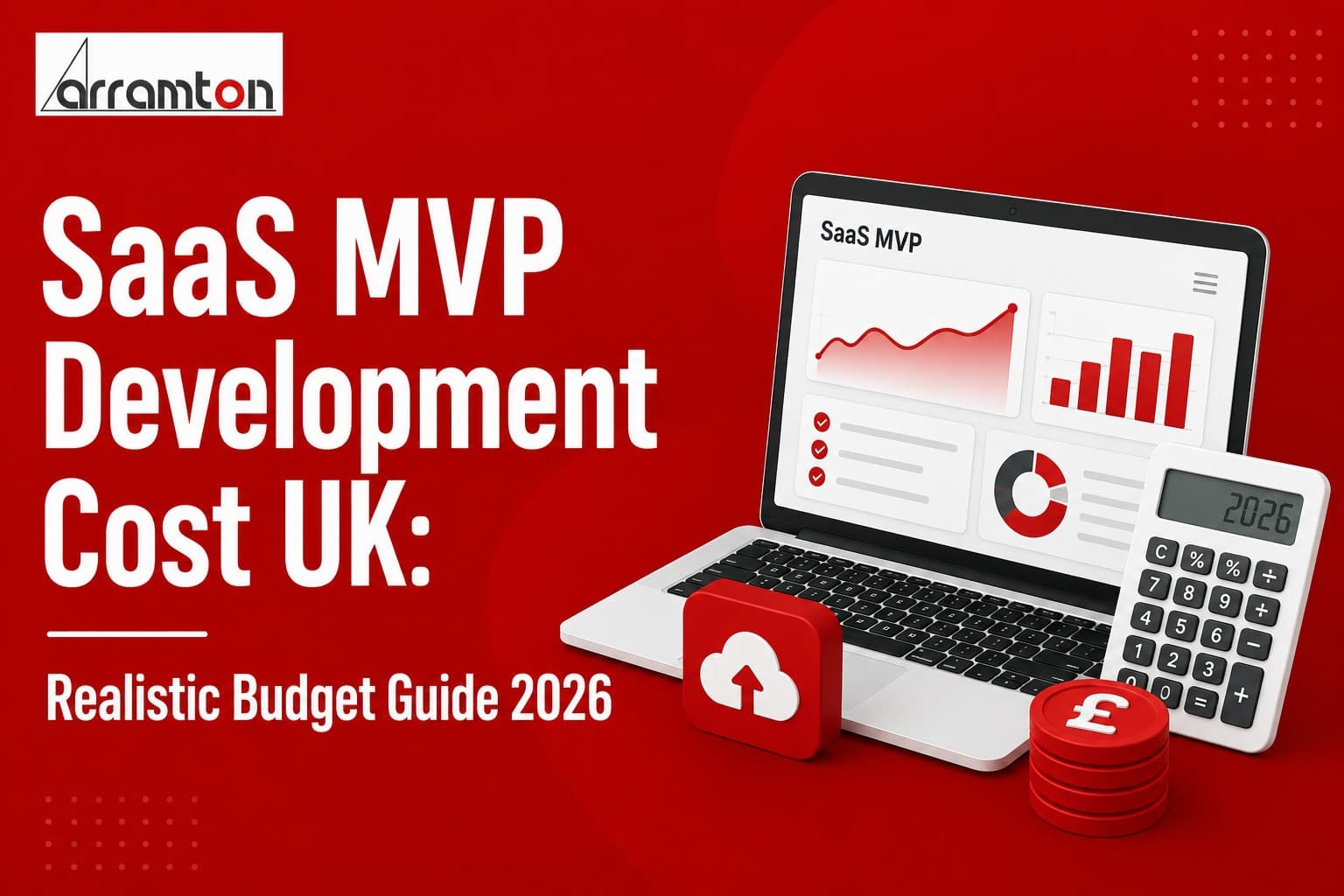
Most SaaS founders in the UK either dramatically underestimate their MVP development costs or overestimate what their MVP should actually be. The truth is, a lean, well-architected Minimum Viable Product for a SaaS application in 2026 typically falls within a £20,000 to £80,000 budget when built by a UK-based agency. Anything significantly cheaper often signals compromises in architecture that will cost you dearly later.
What Is a SaaS MVP? (And What It Isn't)
A SaaS MVP, or Minimum Viable Product, is the leanest version of your software that can deliver core value to early adopters and allow you to gather feedback for future development. It's not a half-finished product or a collection of random features. It's a single, cohesive workflow that solves a specific problem for a defined user group.
What it isn't, is a product with all the bells and whistles. It doesn't include advanced reporting, team collaboration features if they aren't the core value, or native mobile apps from day one. Building these prematurely is how startups burn through cash before proving market fit. At Arramton, we've seen dozens of UK startups struggle with scope creep on their MVPs, turning a planned 3-month project into a 9-month slog. The focus must remain laser-sharp on validating the core problem-solution hypothesis.

SaaS MVP Cost UK 2026: The Ranges and What Drives Them
Understanding the cost of a SaaS MVP in the UK for 2026 requires looking beyond a single number. Pricing is dictated by complexity, feature set, and the development partner's location and experience. A simple SaaS MVP with 1-2 core features, a web-only interface, and basic authentication and billing capabilities typically ranges from £20,000 to £45,000.
Stepping up to a standard MVP with 3-5 features, a web app alongside a basic admin dashboard, user management, and Stripe integration will push the budget to £45,000 to £80,000. For more complex scenarios like multi-tenant architectures, role-based permissions, or custom integrations, expect costs to range from £80,000 to £150,000. These estimates are for UK-registered agencies leveraging modern development stacks and best practices. Offshore-only providers might quote lower figures (£12,000-£30,000), but this often reflects template-driven development, limited testing, and an architecture that hinders scaling, ultimately costing more in the long run.
The technical debt incurred by an improperly built MVP is one of the most significant silent killers of SaaS businesses. Your architectural choices now will directly impact your ability to grow users and features without a complete rewrite in 18–24 months.
SaaS MVP vs Full Product: What to Build First
The distinction between an MVP and a full product is critical for budget management and market validation. Your SaaS MVP should focus on the absolute minimum required to solve the primary user problem. This includes core functionality, a user authentication system, a basic admin panel for your internal use, and essential billing infrastructure, even if you aren't charging users yet.
Leave out features that are 'nice-to-haves' rather than 'must-haves' for your initial user group. This means deferring advanced analytics, complex team management tools, or native mobile applications. Multiple pricing tiers are also best avoided initially; start with one plan and iterate based on user behaviour. A common pitfall is building for imagined users instead of the specific individuals you've already engaged with. Validation, not feature completeness, is the MVP's goal.
Frontend vs Backend vs Infrastructure: Cost Breakdown
When budgeting for your SaaS MVP, it's useful to break down costs by the main technical components. The frontend, the user-facing interface, often requires 30-40% of the development effort for a typical web application, focusing on creating an intuitive and responsive user experience.
The backend, which handles business logic, data management, and APIs, usually consumes 40-50% of the development time. This is where the core functionality and data processing occur. Finally, infrastructure and DevOps—setting up servers, databases, CI/CD pipelines, and monitoring—typically account for 10-20% of the initial MVP build, but this percentage grows significantly as the product scales. For an MVP, we often leverage managed cloud services like AWS RDS for databases and Heroku or AWS Elastic Beanstalk for deployment, balancing cost and complexity.
This breakdown helps allocate resources effectively. For example, a complex algorithm driving your SaaS value will necessitate a larger backend investment. Conversely, a highly visual product might lean more on frontend development hours.

Authentication, Billing, and the Hidden SaaS Plumbing Costs
Authentication and billing are not optional extras for a SaaS MVP; they are foundational. Building a secure user authentication system, managing sign-ups, logins, password resets, and potentially role-based access, can consume 15-25% of your MVP development hours. This isn't a feature to cut corners on; security breaches early on can be fatal.
Billing implementation is similarly crucial and often underestimated. Beyond simply taking a payment, you need to handle subscriptions, trial periods, plan changes, failed payments (dunning), and potentially invoicing. Integrating with payment gateways like Stripe adds significant complexity. Many teams underestimate the number of edge cases within a billing system – failed cards, expired cards, refunds, and compliance like VAT for UK/EU customers. Retrofitting robust billing into a system built without it is a costly mistake.
How Long Does a SaaS MVP Take to Build in the UK?
The timeline for building a SaaS MVP in the UK is directly tied to its complexity and the chosen development partner. A very simple MVP, with one core feature and minimal user management, might take 3-4 months to build. A standard MVP with 3-5 core features, a web app and admin interface, and basic integrations will more realistically take 5-7 months.
More complex MVPs requiring custom architecture, integrations, or sophisticated logic can extend to 8-12 months or longer. This timeline assumes a focused scope and a collaborative client relationship. It's important to factor in discovery and design phases, which can add 4-6 weeks upfront. For founders in London looking to speed things up, clearly defined requirements and prompt feedback are essential. Building a SaaS MVP is a sprint, but it requires careful planning to avoid early exhaustion.

Stripe, Chargebee, and SaaS Billing: What to Use and What It Costs
Choosing the right billing system is a strategic decision for your SaaS MVP. For basic subscriptions and one-off payments, Stripe is the dominant player, offering robust APIs and good documentation. A basic Stripe integration for charging a card with webhook handling for payment events can take 20-30 development hours, costing roughly £1,500-£3,000.
However, if your model involves multiple plans, trial periods, proration, or usage-based billing, you'll likely need Stripe Billing or a dedicated subscription management platform like Chargebee. Implementing full SaaS billing with these features can require 60-100 development hours, costing £5,000-£10,000 for the integration itself, plus the platform's own subscription fees. Chargebee's basic plan starts around £250/month, and Stripe Billing has per-transaction fees. Consider your pricing strategy carefully, as changing your billing model post-launch is one of the most expensive refactors a SaaS business can undertake.
When to Build vs Buy vs Subscribe for SaaS Components
Not every part of your SaaS MVP needs to be custom-built. Evaluating whether to build, buy, or subscribe to a component can significantly impact cost and time-to-market. For foundational elements like authentication, you might subscribe to services like Auth0 or Clerk. These handle the heavy lifting of secure login flows, often with generous free tiers for early-stage products. Auth0's free tier supports up to 7,000 users, which is more than enough for most MVPs.
For common functionalities like email notifications, subscribing to a service like SendGrid or Postmark is almost always more efficient and cost-effective than building your own. However, if your core value proposition lies in a unique algorithm or a highly specialised data processing engine, this is precisely what you should build. The decision hinges on whether the component is part of your unique IP or a standard utility that can be acquired off-the-shelf. Many successful UK SaaS products started on no-code tools like Bubble or Webflow to validate ideas rapidly before committing to custom development.
Get a SaaS MVP Quote
When you're ready to move from planning to execution, getting an accurate SaaS MVP quote is paramount. This involves a detailed discovery phase where your requirements are translated into a technical specification. A reputable agency will ask about your target users, core problem, desired features, and long-term vision.
Be wary of quotes that seem too low – they often hide scope limitations or quality compromises. A realistic quote from a UK-based software development company will reflect the complexities of modern SaaS architecture, robust testing, and a skilled team. If you're exploring custom development for your SaaS MVP and want transparent pricing based on proven methodologies, Arramton builds bespoke software solutions for UK and US companies, focusing on building for scale from day one.
FAQs
Q1: How much does a SaaS MVP cost to build in the UK in 2026?
Simple SaaS MVP (1-2 core features, web only, basic authentication and billing): £20,000-£45,000. Standard SaaS MVP (3-5 features, web app + basic admin, Stripe integration, user management): £45,000-£80,000. Complex SaaS MVP (multi-tenant architecture, role-based permissions, integrations, custom reporting): £80,000-£150,000. These ranges assume a UK-registered agency using modern tooling. Cheaper quotes are available from offshore-only providers (£12,000-£30,000 for equivalent features) but typically reflect template-based development, limited test coverage, and infrastructure setup that requires significant rework at scale. SaaS is where technical debt costs most — your architecture at MVP stage shapes your scaling capability for years.
Q2: What should be in a SaaS MVP and what should be left out?
In: the one workflow that solves the core problem (nothing more), user authentication, basic admin/dashboard for you to manage the product, one integration that's essential to the value proposition, and billing infrastructure (even if you don't charge yet — retrofitting billing is expensive). Out: advanced reporting, team collaboration features (if they're not the core value), mobile apps (ship web first, prove value, then build native), multiple pricing tiers (one plan until you have users to learn from), and third-party integrations beyond the essential one. The most common SaaS MVP mistake: building features for imagined users rather than the specific 10 users you've already spoken to.
Q3: What SaaS infrastructure costs should I budget for in year 1?
AWS/GCP/Azure hosting: £150-£800/month depending on usage (start small, scale as needed). Database (RDS or managed Postgres): £50-£200/month. Email delivery (SendGrid, Postmark): £20-£100/month depending on volume. Authentication (Auth0, Clerk): £0-£300/month depending on MAUs (free tiers are generous for early stage). Error monitoring (Sentry): £20-£80/month. Customer support tooling (Intercom, Crisp): £50-£300/month. Stripe processing fees: 1.4% + 20p per UK card transaction (2.9% + 30c for US cards). Total year 1 infrastructure budget for an early-stage SaaS: £5,000-£15,000 depending on user volume and your choices between self-managed and managed services.
Q4: Should I use a no-code tool like Bubble or Webflow instead of custom development for my SaaS MVP?
No-code is worth considering when: you have no technical co-founder, you need to validate the idea in weeks not months, your workflows are standard (CRUD operations, basic automation, simple data relationships), and you expect to rebuild properly if it gets traction. Custom development is worth the higher upfront cost when: your core value is in the algorithm or data processing (no-code can't express complex business logic efficiently), you anticipate significant user growth (no-code platforms have hard scaling limits), you need integrations with systems that no-code tools can't connect to, or you plan to raise investment (investors often require custom-built products for serious funding rounds). Many successful UK SaaS products started on Bubble or Glide — the rebuild cost later was worth the fast validation.
Q5: How much does Stripe integration add to SaaS MVP development cost?
Basic Stripe integration (charge a card, webhook for payment events, basic subscription): 20-30 hours of development, £1,500-£3,000. Full SaaS billing implementation (Stripe Billing with multiple plans, trial periods, proration, invoice generation, usage-based billing, customer portal, dunning for failed payments): 60-100 hours, £5,000-£10,000. The gap is large because billing edge cases are numerous: failed cards, card expiry, plan upgrades mid-cycle, refunds, VAT handling for UK/EU customers, and the customer-facing billing portal. Get billing right at MVP stage — retrofitting usage-based pricing or multi-tier billing into a system built for simple subscriptions is one of the most expensive engineering tasks a growing SaaS faces.
Conclusion
Building a SaaS MVP in the UK isn't about launching with every feature you can imagine—it's about validating your core idea with the right architecture, the right technology, and a realistic budget. In 2026, most UK SaaS MVPs will require an investment between £20,000 and £80,000, with costs varying based on complexity, integrations, security, and long-term scalability.
Rather than chasing the lowest development quote, focus on building an MVP that is technically sound, secure, and easy to evolve as your product gains traction. Prioritise the features that solve your users' primary problem, leverage proven third-party services where appropriate, and avoid unnecessary complexity that delays launch. A well-planned MVP not only helps you reach the market faster but also reduces technical debt and costly rebuilds as your business grows.
If you're planning to launch a SaaS product in 2026, invest time in defining your scope, validating your assumptions with real users, and choosing a development partner that values transparency and scalable engineering. The right decisions at the MVP stage can save months of redevelopment and position your SaaS for sustainable growth.