Hiring a full-time developer in the UK often feels like the only path to growth. Yet, many businesses are finding this route slow, expensive, and fraught with unforeseen complexities. This is particularly true for scale-ups wrestling with fluctuating project demands or needing specialised skills for a short-term push. The truth is, a rigid 'full-time only' hiring strategy can actually stifle innovation and drain budgets faster than anticipated.
The Hidden Costs of a Full-Time Tech Team
Building an in-house engineering department sounds like the gold standard for control and long-term investment. But dig a little deeper, and the real expenditure becomes clear. Beyond the advertised salary, consider the national insurance contributions, pension schemes, holiday pay, sick leave, and the inevitable overhead of office space and equipment. For a senior .NET developer in London, the fully-burdened cost can easily hit £80,000-£100,000 annually, a significant outlay for a role that might only be 70% utilised during quieter project phases.
These ongoing commitments create inflexibility. When a critical project ends or a market shifts, you're left with expensive, under-utilised talent. This financial inertia can prevent businesses from pivoting quickly or taking on exciting new opportunities that require a different skill set entirely.
When 'More Hands' Isn't the Answer
Most founders assume that if they need more development capacity, the answer is simply to hire more permanent staff. This is a common pitfall, especially when project timelines are tight and specific expertise is paramount. The recruitment process itself can take months, involving job postings, sifting CVs, multiple interview rounds, and background checks. During this extended period, your existing team is often overloaded, leading to burnout and reduced output quality.
Furthermore, even after a successful hire, integrating a new team member requires onboarding time and managerial attention. This initial period, where productivity is lower, adds further delay and cost. For a fast-moving startup, this delay can mean missing a critical market window or falling behind a competitor.

Recognising the Signs Your Business Needs Augmentation
So, how do you know when staff augmentation is the smarter choice over traditional hiring? It boils down to identifying specific triggers that signal a mismatch between your current capacity and your immediate or future needs. Here are the most common indicators:
- Sudden Project Surges: You’ve landed a large new client, secured unexpected funding, or need to rapidly develop a new feature set. Your existing team is already at full capacity, and hiring permanent staff would be too slow.
- Specialised Skill Gaps: You need expertise in a niche technology—perhaps advanced machine learning, a specific blockchain framework, or highly specialised front-end tooling—that your current team doesn't possess and won't need long-term.
- Tight Deadlines & Market Windows: A competitor is about to launch a similar product, or there’s a crucial event driving a need for rapid deployment. You need skilled professionals immediately, not in 3-6 months.
- Budgetary Constraints & Predictability: You need to control costs and have a predictable monthly expense, rather than the unpredictable overheads of a full-time hire with all associated benefits and potential for longer-term commitment.
- Geographic Expansion or Market Testing: You’re exploring a new market (like the US) and want to test its viability or need local market insights and developers without establishing a full physical presence.
Staff Augmentation vs. Full-Time: A Direct Comparison
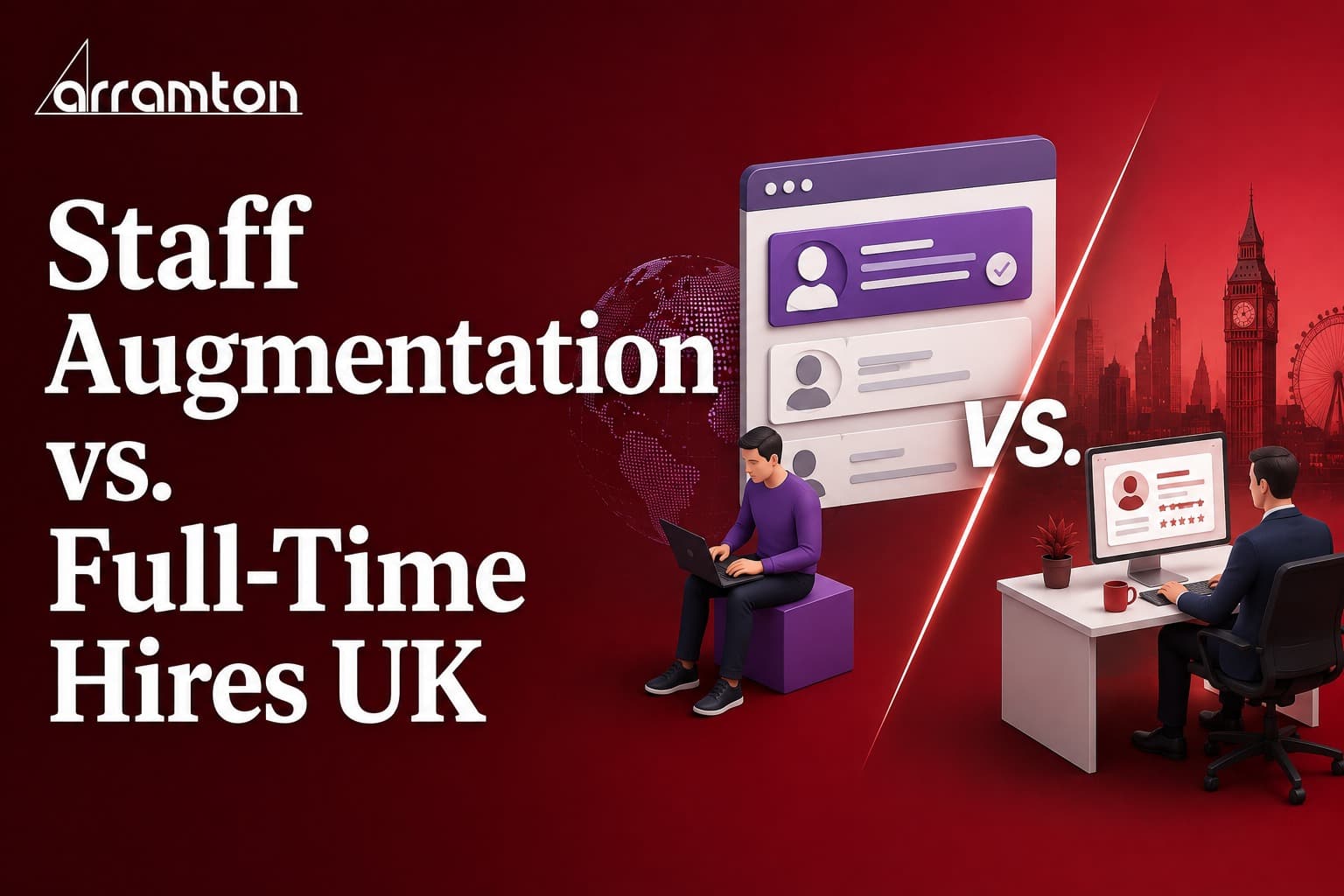
The core difference lies in agility and focus. Full-time hires are about building long-term internal capability. Staff augmentation is about plugging immediate, specific gaps with highly skilled professionals on a flexible basis. At Arramton, we've seen this pattern across 30+ projects — businesses often underestimate the true cost and time to hire senior developers in the UK, only to find augmentation offers a faster, more cost-effective solution for urgent needs.
When you engage staff augmentation, you're essentially renting expertise. This allows you to scale up or down rapidly without the burden of long-term commitments, severance packages, or the overheads of permanent employment. For a London-based fintech scaling its platform, bringing in two senior Python developers for six months via augmentation might cost £40,000 total, compared to potentially £160,000+ for two full-time hires over the same period, including all burdens.
Focus on Core Competencies
With augmentation, your internal team can remain focused on strategic initiatives and core product development, while the augmented staff handle specific tasks or projects. This division of labour maximises efficiency and ensures that your in-house talent is always working on high-value activities.
Access to Global Talent Pools
While this article focuses on UK businesses, the principle extends globally. Outsourcing staff augmentation allows access to a wider talent pool, not limited by geography. This can be crucial for finding specialised skills or more cost-effective rates, especially for tasks that don't require deep integration with your core UK team or intellectual property concerns.

Common Pitfalls to Avoid with Augmentation
While powerful, staff augmentation isn't a silver bullet. Several common mistakes can undermine its effectiveness:
- Poor Skill Matching: Simply hiring 'a developer' without clearly defining the exact technical and soft skills required. This leads to a mismatch and wasted time.
- Lack of Clear Communication Channels: Augmenting a team requires robust communication. Without well-defined processes and tools (like Slack, Jira, and regular video calls), tasks can get lost, and misunderstandings can occur.
- Treating Augmented Staff as Contractors, Not Colleagues: While they may not be permanent, integrated augmented staff who feel valued and included are far more productive. Foster a sense of team, even with external members.
- Not Defining Project Scope Clearly: Augmentation works best when the scope of work for the augmented team is well-defined. Ambiguity leads to scope creep, much like with permanent hires, but with added contractual complications.
Making the Right Choice for Your UK Business
The decision between hiring full-time staff and opting for staff augmentation hinges on your business's current stage, project demands, and strategic goals. If you're a startup needing to build an MVP rapidly and are unsure of long-term needs, augmentation offers crucial flexibility. If you're a scale-up with consistent growth and a need for stable, in-house expertise, a gradual build of your permanent team makes sense.
However, for many UK businesses facing unpredictable project cycles or needing specialised skills for defined periods, staff augmentation presents a compelling, agile, and cost-effective solution. It allows you to access top talent precisely when and where you need it, without the long-term financial and operational burdens of traditional hiring. For a founder in Manchester, this can mean launching a new product on time and within budget, securing that vital next round of investment.
FAQ
When should I consider staff augmentation for my UK business?
You should consider staff augmentation when you have sudden project demands, require specialised skills for a limited time, need to meet tight deadlines, or want to control costs more predictably than with full-time hires.
Is staff augmentation more expensive than hiring full-time in the UK?
Typically, no. While hourly rates for augmented staff might seem high, the overall cost is often lower due to eliminating recruitment fees, benefits, overheads, and the time value of faster project completion.
What are the key benefits of staff augmentation for UK SMEs?
Key benefits include rapid scaling, access to niche skills, increased project velocity, cost predictability, and the ability for your core team to focus on strategic development.
How do I ensure effective communication with augmented developers?
Establish clear communication protocols, use collaborative tools (like Slack, Jira), schedule regular video check-ins, and assign an internal point person to manage the augmented team's workflow and integration.
The Strategic Advantage of Agility
Most businesses get this wrong by defaulting to permanent hires without a thorough analysis of current and future needs. The truth is, the most successful companies are those that can adapt quickly. If you're evaluating partners for this kind of work, Arramton builds custom software solutions for UK and US companies, including providing agile teams that integrate seamlessly with your existing operations. Our expertise helps businesses like yours navigate the complexities of scaling development capacity effectively.