Defining the Models: Staff Augmentation vs Outsourcing vs Managed Teams
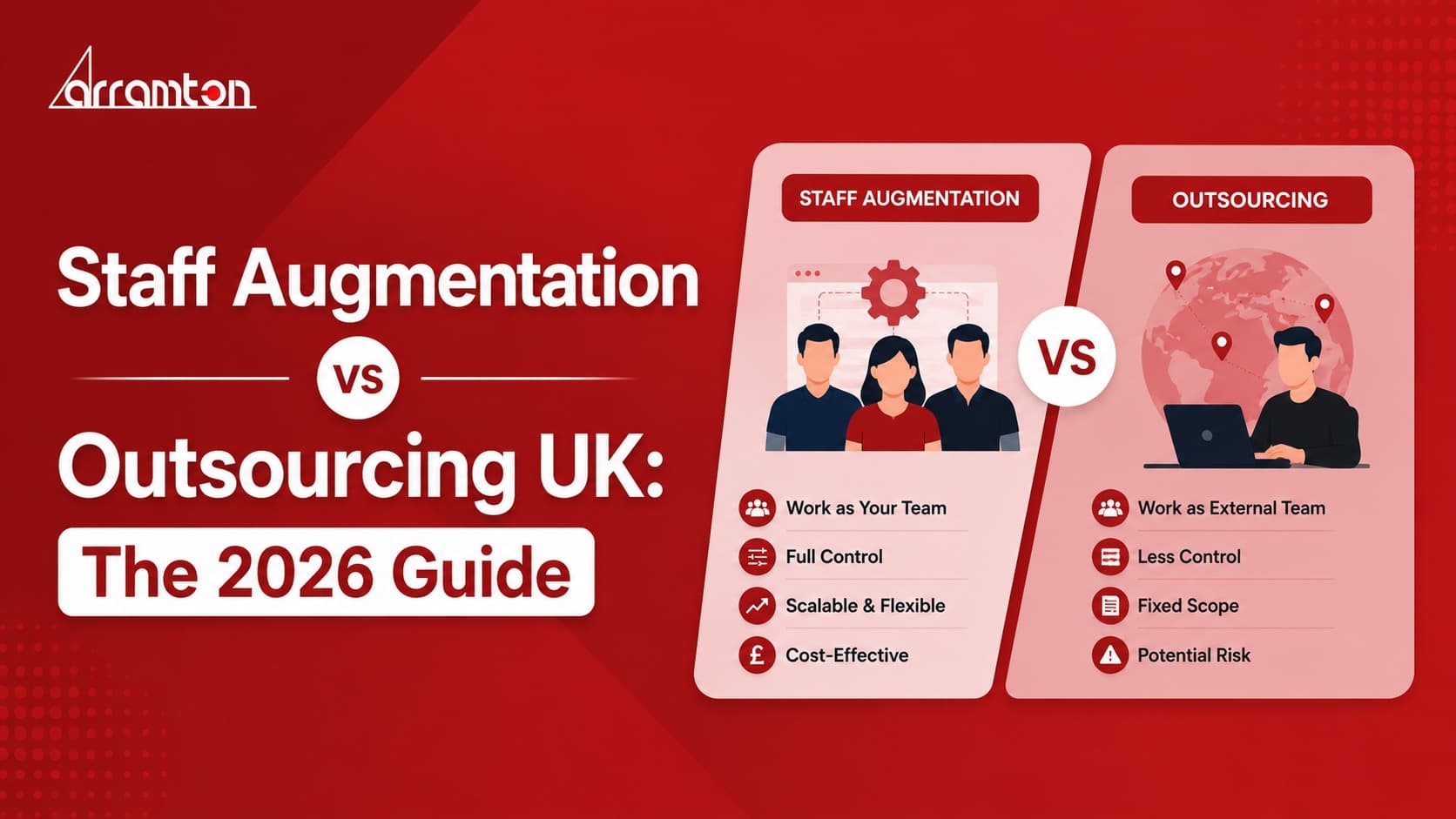
Deciding how to expand your development capacity involves a crucial choice: staff augmentation, outsourcing, or managed teams. Each model offers a different approach to integrating external talent into your operations, impacting cost, control, and project outcomes. Understanding these distinctions is key for UK businesses aiming to scale efficiently in 2026. Staff augmentation involves hiring individual developers who integrate directly into your existing team, working under your management. Outsourcing, conversely, typically means delegating a specific project or a defined set of tasks to an external agency. Managed teams sit somewhat between these, offering a pre-formed team with a dedicated lead, still operating with a degree of external oversight but with more integrated delivery.
Cost Comparison: Staff Augmentation vs Outsourcing UK 2026
For equivalent developer quality, staff augmentation typically costs 20-35% less than fixed-price outsourcing for the same output. This significant difference stems from several factors inherent in each model. Outsourcing agencies add project management overhead, often between 10-20% of the project cost, plus a risk buffer for scope uncertainty, adding another 15-25%. These premiums are layered on top of the raw developer wages. Staff augmentation, on the other hand, is closer to the direct developer cost, with a transparently applied margin. However, it's vital to calculate the total cost of engagement, not just developer day rates, as outsourcing inherently includes project management you might otherwise need to provide internally.
If your organisation lacks a dedicated technical project manager or CTO, the premium for outsourcing can sometimes be justified by the included management capacity. This can prevent you from needing to hire or allocate scarce internal resources to manage the external developer effectively. The decision hinges on your internal capabilities and the total value delivered, not just the hourly rate.

Control and Flexibility: Where Each Model Wins
Staff augmentation offers unparalleled control and flexibility. You handpick the developers, define their roles, and dictate their daily tasks. This direct oversight ensures the developer aligns perfectly with your company culture and project specifics. This model is ideal when you need to retain tight control over intellectual property, development processes, and the overall direction of the product. Flexibility is also a major win; you can scale the team up or down with relative ease, typically with a 30-day notice period, adapting quickly to changing business needs.
Outsourcing, particularly fixed-price projects, trades some control for predictability. The agency manages the team and the delivery, which can free up your internal resources significantly. However, flexibility can be limited. Changing scope mid-project often incurs additional costs and requires formal change control processes. While managed teams offer a middle ground, providing a structured team with a lead, the ultimate day-to-day granular control typically remains with the external provider, simplifying your management overhead but reducing your direct influence on individual task execution.
When Your Project Needs Outsourcing (Not Staff Aug)
Outsourcing shines when you have a well-defined project with clear deliverables and minimal expected scope changes. For instance, building an MVP for a new SaaS product, where the core features are locked down, is a prime candidate for outsourcing. This model is also suitable if you lack the internal technical expertise to manage developers or even define tasks effectively. The agency brings its own project management, quality assurance, and technical leadership, absorbing much of the complexity. A London-based startup aiming to launch its first product quickly, without a dedicated tech lead, would benefit from the comprehensive service outsourcing provides.
The truth is, most businesses underestimate the managerial overhead involved in a solo developer. When project complexity is high and internal technical oversight is low, outsourcing to a competent agency is often the less risky path to a completed product. This approach ensures that the project is managed by experienced professionals who are accountable for the end-to-end delivery, rather than relying on your team to guide every step.
When Your Project Needs Staff Aug (Not Outsourcing)
Staff augmentation is the superior choice when you need to scale your existing team with specialised skills or fill immediate capacity gaps. If you already have a strong technical lead or CTO managing your development efforts, adding a dedicated developer through augmentation is a seamless process. This is perfect for companies like a Manchester-based e-commerce business needing to rapidly develop new platform features or enhance existing functionality. You gain access to skilled individuals who become an extension of your in-house team, working collaboratively and retaining your established development practices.
This model is also vital for projects where flexibility and direct control are paramount, such as ongoing development cycles or product iterations where requirements may evolve. It allows you to maintain agility, ensuring your development efforts remain aligned with your evolving business strategy. The inherent IP ownership and direct integration mean your intellectual property is always secure within your own infrastructure.
IR35 Impact on Each Model
IR35 legislation in the UK is a critical consideration, impacting how external talent is engaged. For staff augmentation, the crucial factor is demonstrating genuine employment status, not disguised employment. HMRC scrutinises whether the augmented developer is treated as an employee by the client. If the client dictates hours, provides equipment, and has the right of supervision, direction, and control, IR35 may apply, requiring the client (or the fee-payer) to operate PAYE. This means careful contract structuring and operational practices are essential to remain outside IR35.
Outsourcing, particularly when contracting with a reputable agency for a defined project outcome, generally falls outside IR35. The fee is paid to the company, not the individual, and the agency is responsible for managing its own workforce's employment status and tax obligations. This provides a clearer path for businesses seeking to avoid the complexities of IR35 when expanding their development capabilities. However, it's always prudent to seek specialist advice to ensure compliance for both models.

Quality and Accountability: The Honest Comparison
Quality and accountability differ significantly between the two models. With staff augmentation, you have direct oversight of the developer's work. You conduct code reviews, manage their tasks, and are directly involved in ensuring quality. Accountability lies with your internal management, but the developer is directly answerable to you. This direct relationship can foster strong accountability if managed well. For a US Series A fintech building its core platform, having developers directly integrated and managed by their CTO ensures a high degree of accountability for critical code.
In outsourcing, accountability rests with the agency. They are contractually obligated to deliver a certain quality and outcome. While you have recourse through the contract, your direct influence on the day-to-day quality assurance is limited. The agency's internal QA processes become paramount. If the outsourced project falls short, your recourse is through the contract, which can be a lengthier process than addressing an issue with an augmented team member. The risk is that the agency might prioritise delivery speed over deep quality if not managed meticulously.
Hybrid Approach: How UK Companies Combine Both Models
Many forward-thinking UK companies are adopting a hybrid approach, leveraging the strengths of both staff augmentation and outsourcing. For example, a mid-sized firm might use outsourcing for the initial development of a complex SaaS platform, benefiting from the agency's end-to-end project management and expertise. Once the core product is stable and market-ready, they might transition to staff augmentation to bring on board dedicated developers who can iteratively enhance and maintain the product, integrating deeply with the in-house team.
This strategy allows businesses to achieve rapid initial delivery with external support while retaining long-term control and flexibility for ongoing development. It’s a pragmatic way to manage both budget and strategic objectives. At Arramton, we've seen this pattern across over 30 projects; companies often start with a defined outsourced project to de-risk initial build, then transition to staff augmentation for scaled, agile feature development. This ensures they get the best of both worlds: structured delivery and integrated team growth.
Which Model Is Right for You? Decision Framework
The choice between staff augmentation and outsourcing hinges on several key factors. Ask yourself: do you have strong internal technical management? If yes, staff augmentation offers cost savings and flexibility. If not, outsourcing or a managed team might provide the necessary structure. What's your appetite for risk regarding scope changes? Staff augmentation handles evolving requirements better, while outsourcing (especially fixed-price) is better suited for stable scopes. Consider your budget; staff augmentation is typically more cost-effective for long-term engagements, whereas outsourcing can offer cost certainty for well-defined projects.
Finally, evaluate your need for direct control over processes and IP. Staff augmentation provides maximum control, embedding developers into your workflow. Outsourcing delegates much of this to the agency. For a UK startup founder evaluating their options for building their first B2B application, weighing the upfront cost savings of staff augmentation against the managed delivery of outsourcing is a critical decision. It's not about which model is universally 'better', but which aligns with your current operational capacity, strategic goals, and risk tolerance for 2026 and beyond.

FAQs
Q1: Is staff augmentation cheaper than outsourcing in the UK?
For equivalent developer quality, staff augmentation typically costs 20-35% less than fixed-price outsourcing for the same output. Why: outsourcing agencies add project management overhead (10-20% of project cost), risk buffer (agencies price for scope risk, adding 15-25%), and profit margin on top of developer costs. Staff augmentation is closer to raw developer cost with a transparent margin. However, outsourcing includes project management you'd otherwise need to provide internally — if you don't have a technical PM or CTO, the outsourcing premium is sometimes worth paying rather than hiring project management capacity. Calculate total cost of engagement, not just developer day rates.
Q2: Can I switch from outsourcing to staff augmentation mid-project?
Yes, but with planning. The transition typically happens at a natural phase boundary — end of MVP, post-launch stabilisation, or start of a major new feature stream. Steps: conduct a code handover and audit (what's built, what's the architecture, what's the tech debt), transfer all documentation and credentials, ensure the incoming staff augmentation developer has a 2-week overlap with the outgoing project team if possible. The risk of mid-project transition is knowledge loss — the outsourcing team has context that lives in people, not documentation. Budget 2-4 weeks of reduced velocity during the transition for a mid-complexity project.
Q3: Who manages the work in a staff augmentation model?
You do — or your internal technical lead. This is the fundamental requirement for staff augmentation: you must have someone capable of breaking down requirements into tasks, reviewing code output, and unblocking the developer when they hit questions about your product. If you're a non-technical founder without a CTO or senior developer internally, pure staff augmentation will underperform — the developer needs technical direction. Options: hire a fractional CTO alongside your staff augmentation team, start with an outsourced project to build the initial product (then transition to staff aug for ongoing development), or use a managed team model (we provide a team lead as part of the engagement).
Q4: What are the exit terms for staff augmentation versus outsourcing?
Staff augmentation: typically 30-day notice to scale down or end an engagement. Some providers require 60-day notice for senior roles. No project completion milestones — you pay for time, not deliverables, so exit is cleaner. Outsourcing: governed by the project contract — you exit at milestone completion or by triggering a change control process. Early exit from a fixed-price contract often involves a kill fee (20-50% of remaining project value) or dispute about delivered value vs contracted scope. Staff augmentation offers more flexibility; outsourcing offers more predictability on project cost if scope is truly fixed. If scope will evolve (it always does), staff augmentation's flexibility pays off over a 6-12 month engagement.
Q5: What happens to the code if I stop a staff augmentation engagement?
All code written during a staff augmentation engagement with Arramton is your IP — it lives in your repository from day one. We work in your GitHub/GitLab, on your cloud accounts, and you have full access to everything throughout and after the engagement. There's no code handover process because the code was never ours — it's always been yours. This is structurally different from some outsourcing arrangements where code lives in the agency's infrastructure and requires a formal handover. Our contracts include explicit IP assignment confirming this. Always verify this before signing any development services agreement.
Conclusion
Choosing between staff augmentation, outsourcing, and managed teams isn't about finding a universally better model—it's about selecting the approach that best aligns with your business goals, technical capabilities, and project requirements. If your organisation already has a strong engineering leadership team and needs to scale quickly while retaining complete control over development, staff augmentation offers the flexibility, cost efficiency, and transparency needed for long-term growth. Conversely, businesses without in-house technical management or those delivering a well-defined project with fixed requirements may benefit more from outsourcing or a managed team model.
Many successful UK businesses now adopt a hybrid strategy, outsourcing the initial product build before transitioning to staff augmentation for ongoing feature development and product evolution. By evaluating factors such as project complexity, budget, internal expertise, and compliance considerations like IR35, you can confidently choose a model that supports sustainable growth.
If you're exploring how dedicated developers can seamlessly integrate with your existing engineering team, learn more about our Staff Augmentation Services and discover how Arramton helps UK businesses scale development teams with experienced, pre-vetted software engineers while maintaining complete ownership of code, processes, and delivery.